
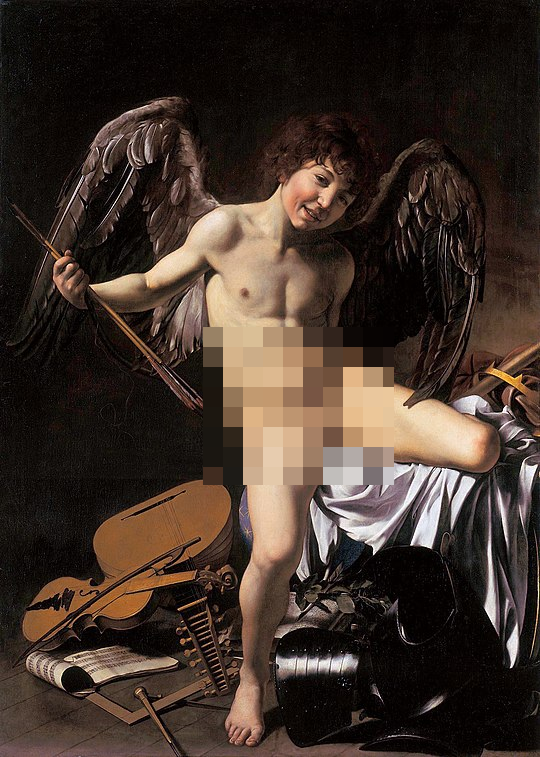
Caravaggio
1601–1602
Medium Oil on canvas
Dimensions 156 cm × 113 cm (61 in × 44 in)
Location Gemäldegalerie, Berlin
In 1602, Caravaggio completed Amor Vincit Omnia, or Love Conquers All. It was the kind of work only Caravaggio could create: Cupid, standing with arrows in one hand, seems to tread casually over symbols of human accomplishment—armor, a lute, a lined notebook—suggesting that love supersedes all human endeavors. The painting was an instant sensation among Rome’s elite, eventually acquired by Vincenzo Giustiniani, an influential nobleman whose brother was a cardinal. Yet, there was a problem: Caravaggio’s Cupid was starkly realistic, even photographic, capturing every line and detail of his model—a twelve-year-old boy in Caravaggio’s circle. This precision was both groundbreaking and unsettling. The painting was displayed only for Giustiniani, veiled by a green curtain, hidden from prying eyes. For nearly 200 years, Love Conquers All remained concealed, seen by very few until it found a permanent home in Berlin. Today, thousands flock to see it annually, captivated by Caravaggio’s depiction of triumph. It took centuries, but in the end, love did, indeed, conquer all.
That 200-year concealment, driven by the collector’s censorship, speaks to our own era in an unexpected way. Today, social media’s “community guidelines” shape what art can be seen and, increasingly, what art can be made. More and more calls for submissions cite these guidelines in their selection criteria, meaning that if a work doesn’t pass the standards of social platforms, it doesn’t stand a chance of being shown in galleries either. Galleries, seemingly in unspoken agreement with social media’s puritanical rules, have begun to prioritize what’s “safe”—art that aligns, art that doesn’t offend. The irony is striking: in an age of unparalleled connectivity, censorship has found a new home.

Where does that leave art’s rebellious spirit, its long history of challenging norms and questioning boundaries? If we continue down this road, we might face a future of impeccably safe, “rule-abiding” art. Why, then, are galleries playing by social media’s rules? Money, perhaps, and the fact that platforms like Instagram have become vital advertising channels for collectors and galleries alike. When money enters the equation, the game inevitably changes.
As for me, I plan to keep creating work that challenges viewers, art that might be hidden from view for another 200 years if that’s what it takes. Because, just as Caravaggio’s Cupid eventually saw the light, I believe that art created with conviction will endure. In the end, love—and truth—conquers all.


 Carlos Fentanes
Leave a comment