On the persistence of cultural censorship across centuries
Charles Darwin was never meant to become Charles Darwin. His father, a wealthy physician, expected him to follow medicine or the church — safe, respectable, predictable. The young Darwin’s passion for collecting beetles, rocks, and fossils seemed frivolous, even embarrassing. When he boarded the Beagle in 1831, it was not with his father’s blessing but with reluctant permission, granted only after family pressure. He returned five years later with the seeds of a theory that would shatter Victorian assumptions about life itself.
The tension here is not between Darwin and science, but between Darwin and expectation. His father was not a villain; he simply carried the norms of his time — a respectable man’s son does not chase butterflies around the world. Censorship, in this sense, rarely comes from a single authoritarian figure. It comes from the weight of what society thinks is acceptable, respectable, or safe.

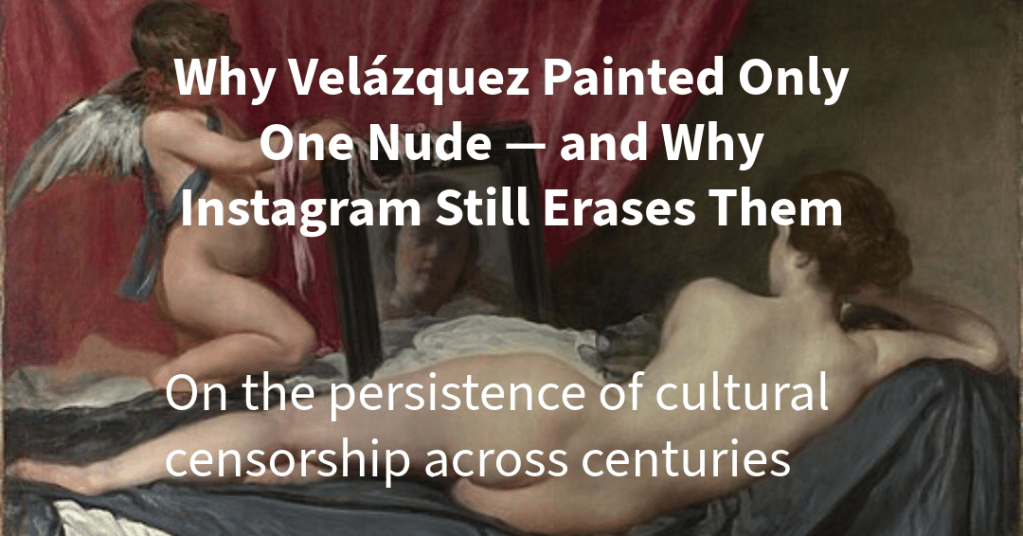
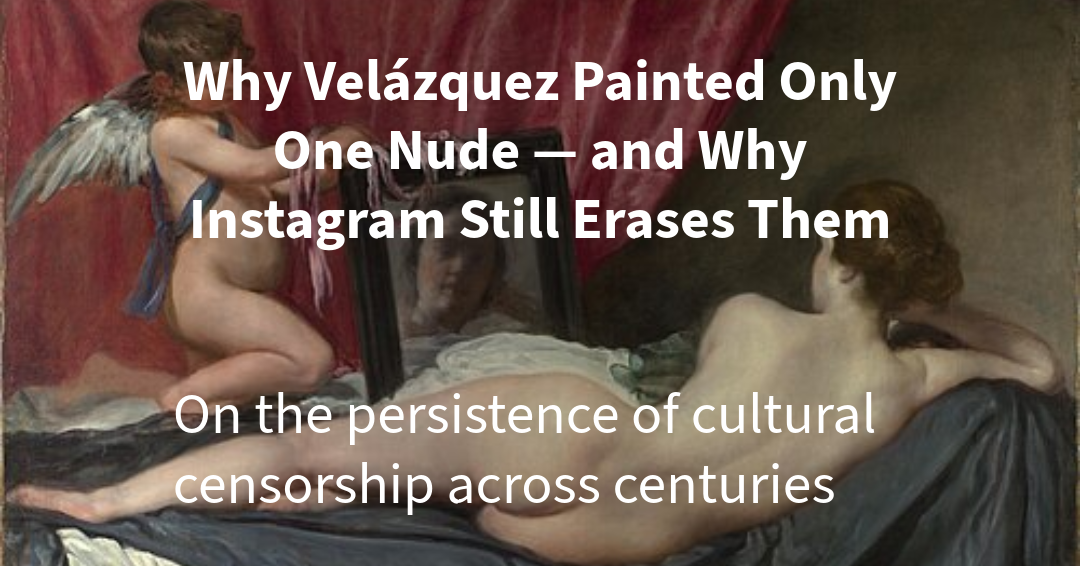
In art, this tension is just as present. Think of Diego Velázquez. In the heart of seventeenth-century Spain — a Catholic empire where the nude was viewed with suspicion — he painted the Rokeby Venus, his only surviving female nude. Compare this to Titian, working in Venice a century earlier, who supplied Spanish monarchs with canvases full of sensual bodies. The difference was not simply geography, but cultural climate. Venice tolerated liberties that Madrid did not. Velázquez had to navigate expectations: court decorum, religious scrutiny, and the gaze of his patrons. His Venus is not bold like Titian’s; she turns her back to us, her face seen only through a mirror. Concealment as survival.
Do you think humans have evolved past these tensions? Think twice. The artist’s patron is no longer a king or emperor but a digital platform. Today, the “court” is Instagram. Follow the Money! The expectation is not religious but economic. The rules are shaped less by bishops than by advertisers, or by the cultural weight of a dominant economy like the United States. A nude painted by Titian, a Mapplethorpe photograph, or even a sketchbook drawing by Schiele may be flagged, blurred, or removed — not necessarily because anyone at Instagram disapproves, but because American norms, born of Puritan roots and corporate caution, still frame the conversation.
And here’s the paradox: the censorship does not really come from Instagram itself, just as it didn’t come only from Velázquez’s king or Darwin’s father. It comes from the cultural soil out of which those institutions grow. If Instagram had been built in France or Sweden, perhaps nudity would be treated as art first and offense second. If Darwin had been French, maybe his father would not have feared scandal in science. If Velázquez had lived in Venice, perhaps he too would have left behind a gallery of Venuses.
Artists today fight not for court appointments but for likes, visibility, and spots in group shows. The restrictions are no longer geographic but algorithmic, no longer about crossing borders but about crossing content filters. The map has shifted, but the struggle remains the same: how to flourish against expectation. If France were economically dominant instead of America, the norms would be different — and the restrictions would be different too. The lesson from Darwin, Velázquez, and Instagram alike is this: censorship is rarely an order; it is an atmosphere. To resist it, we don’t only need new tools (hashtags, alternative platforms), but new climates — a plurality of cultural centers, a digital Venice to balance Madrid. Until then, every artist is Darwin on the Beagle, Velázquez in his studio, navigating a world where the real restriction is not the law, but the weight of what society insists is respectable.


 Carlos Fentanes
Leave a comment