When I arrived at Jorge’s, I had no expectations—only curiosity. He claimed to have found a cure for Parkinson’s. I knew it couldn’t be science, couldn’t be medicine; I had lived long enough beside my mother’s trembling hands to know. I had read the books, the papers, the clinical studies. The cure did not exist. And yet Jorge swore he was healed. Could it be true?
He opened the door and pulled me in before I could speak. The house was vast, quiet, with a kitchen larger than my first apartment after college. Everything gleamed, everything was in its place.
“I’ll make us some tea,” he said. “In the meantime—wash the dishes.”
The words caught me off guard. Wash the dishes? I hated dishes. My mother’s warning echoed: If you don’t study, you’ll end up scrubbing plates in some restaurant. I had studied. I had earned degrees. And still, here I was, standing at the sink of a stranger, washing dishes I hadn’t dirtied.
It felt absurd, even humiliating. I hadn’t come for chores. I was searching for something else — an answer, a cure, a way out. Yet there I was, wrists deep in soap and resentment. My thoughts snagged on a spoon. I remembered the unspillable one I once bought for my mother — the kind that stays level even when hands shake, designed for Parkinson’s. She treated it more like a souvenir I had brought from some faraway land than a tool she might actually use. She even laughed when I suggested she try it. I hadn’t seen it in a while; it sat tucked away somewhere, almost forgotten.
When the dishes were done, I turned to him, already half gone.
“This isn’t for me,” I said. “I should go.”

But Jorge only smiled and handed me a stack of papers. His handwriting spilled across the pages, unpolished, urgent, as if written in a single breath. I sat down and began to read. And with each line, I felt myself stripped of defenses, left exposed, vulnerable.
Wednesday, February 5th
Your unrest does not live outside. It is not in the noise of duty or in the gaze of others. It is born in the way you lean your attention, the weight you give to what surrounds you. Shift the attention, and the shape of the world tilts with it.
Take washing dishes. You think of it as the bottom rung, the task left to those unseen. Yet in the water there is stillness. In the plates, repetition. No one interrupts. Nothing demands. It belongs only to you. What is called low may also be called free.
You imagine punishment. But it is not punishment. It is solitude disguised as labor. Solitude carries lessons—patience, quiet, a different measure of time.
Each act is only what you allow it to be. A broom moves, a hand rinses, a car carries. No gesture higher than another. What shifts them is your gaze. And gaze is everything.
So let the dish reveal its silence. Let the floor disclose its rhythm. Let the car carry you into yourself.
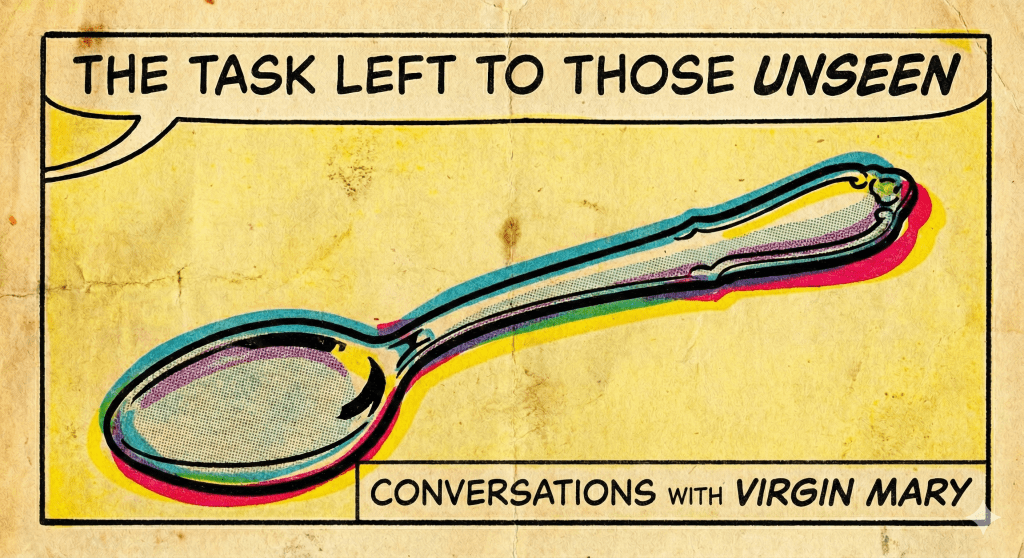
I have a task for you: Tonight, wash a single spoon as if it were the last relic on earth. When it is dry, place it in a special place.
Tomorrow, carry it with you. Slip it into your pocket and do not remove it all day.
When I send my messengers, they will speak of ordinary things — bus schedules, the price of bread, the weather. Yet, out of nothing, they will mention a spoon. Your spoon. That will be my sign, proof that what I am saying is real, not a product of your imagination.
Only in that moment will you recognize that their words were meant for you.
And now, the spoon kept appearing like a secret incantation. Why the spoon, exactly when I had been focusing on spoons? As if the writings had reached into my own head.
“Oh, spooky. Do you really want me to do this kind of ritual? It feels like a gimmick,” I muttered, holding the spoon as though it carried secret weight.
Jorge ignored my protest, pouring tea into two porcelain cups. He handled the pot with the care of a jeweler, but I noticed his hands trembled ever so slightly — not the violence of Parkinson’s, but the faint quiver of someone who had lived with it once. He steadied the cup with a practiced motion, as though he had learned long ago how to make the tremor invisible. “It’s just my own craziness, writing what I hallucinate hearing. I’m a retired chemical engineer trying to put my thoughts in order. I don’t know how to explain this to you. I don’t want you to do anything. The letters aren’t instructions. I don’t even know how to take them. At best, they’re invitations. The worst that can happen is nothing — and you go home, never see me again.”
The spoon in his hand glinted like a code. I frowned. “So it’s supposed to reveal something?”
“You’re giving too much importance to a simple spoon. Truth doesn’t reveal,” he said. “It sneaks up. Sometimes it hides in what you dismiss — a spoon, a thread, a shoe. They’re markers, not messages.”
I laughed nervously. “So I just carry it, and miracles appear? My mother will be cured because I hear about a spoon?”
“No. If you expect miracles, they won’t appear. Maybe nothing happens. Maybe patience does. The object isn’t the point. Attention is.”
I turned the spoon in my palm, absurd and ordinary. For an instant I saw my mother’s spoon, Jorge’s teaspoon, and others shaped by cultures and rituals. England’s delicate teaspoons for afternoon tea, Japan’s lacquered chashaku, even Hollywood’s spoons—domestic props, symbols of rebellion. Small things carrying entire worlds.
“So the miracle isn’t curing anything,” I said. “It’s noticing.”
“Exactly. Notice what is invisible. Everything else is commentary.”
I hesitated, then whispered, “I’ll do it.” Not to him, but to the object itself. And in that silence, I felt the threshold — from disbelief to curiosity, from reason to a world hidden in plain sight. The spoon was the first key.
The next morning I left for work with the spoon in my pocket, as the letters suggested. I didn’t expect anything. In truth, I carried it more as a way of proving Jorge wrong, to show him how hollow these hallucinated instructions were. A spoon in my pocket — absurd.
It was a long drive, two hours to a nearby town where we had installed a test farebox in one of the city buses, the spoon pressed against my thigh as I drove, a quiet reminder of Jorge’s absurd invitation. By noon, I had already forgotten the spoon. I was with the customer, listening to her concerns about the new design. The problem was simple and maddening: dimes. Too small, too slippery, they jammed everywhere once passengers threw them into the slot.
We were going over the complaints when she leaned across the table and said, almost casually:
“You know what the problem is? The handle. If you thought of it like a spoon — you know, with a long handle and a curved part that guides the liquid — you could design something similar for coins and bills. It would flow better.”
I froze.
“Did you say… spoon?”
“Yes,” she replied, puzzled. “Why?”
“Nothing,” I said quickly, though my hand instinctively went to my pocket, feeling the hidden weight. “Just something I was… considering for the next design.”
She nodded, unfazed. “You know, sometimes I get ideas from ordinary objects — a spoon, a thread, a shoe… anything, really.”
“Yes,” I muttered. “A spoon, a thread, a shoe.” My mind was racing. Is the universe conspiring against me?
The conversation moved on, as if nothing had happened. But for me, everything had. It wasn’t thunder or lightning. It wasn’t healing or revelation. It was a single, ordinary word dropped into the river of the day — and suddenly the current shifted.
I walked out of the office with the faint sense that Jorge, or perhaps the letters themselves, had just nudged me into a different kind of story. Ridiculous, yes. But ridiculousness was part of its power. And so, against my better judgment, I carried the spoon home, its weight now part of my own strange story.

 Carlos Fentanes
Leave a comment