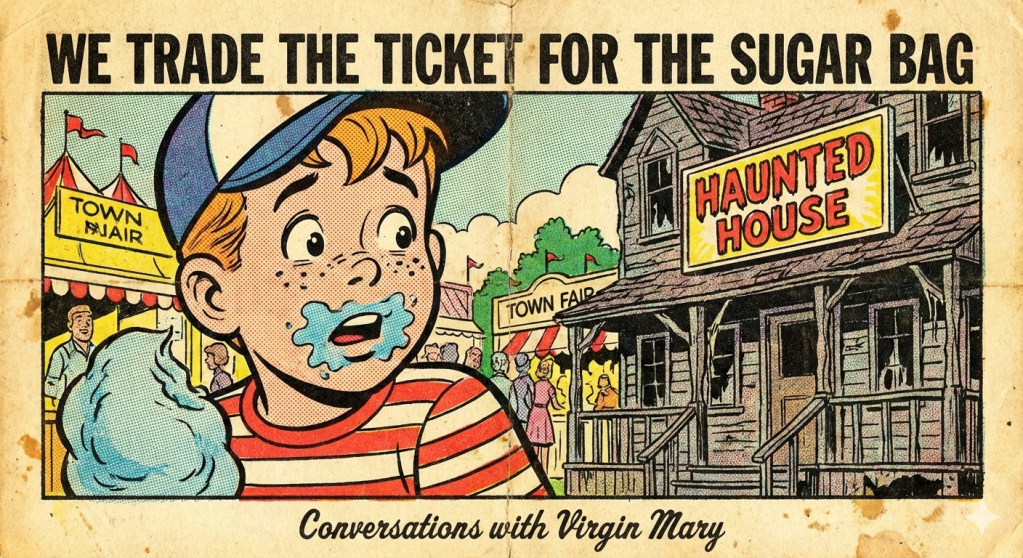
Conversations with Virgin Mary
Tuesday, August 6th
Self-doubt leads to procrastination—your oldest enemy.
Remember that day at the fair? You were six, maybe seven. All your friends lined up for the Haunted House. Your heart was beating—you wanted to go in, and you wanted to run away. In the end, you stayed outside, eating blue cotton candy. When they came out, they told you about the ghosts and werewolves and skeletons inside. You were fascinated by their stories.
And the cotton candy? You don’t remember the taste.
But you still remember the stories.
That’s how excuses work.
We trade the ticket for the sugar bag.
We stay outside and tell ourselves we’re fine.
Throw away the cotton candy. Get in the cart. No excuses.
That’s why I send the messengers.
They appear all around you, all the time—to remind you that now matters, that you matter. But you keep choosing the sugar, the delay, the sweetness of waiting.
My messengers can be ordinary things: a shoelace, a cilantro leaf, a frozen pizza. They’re small, yes—but precise. They bring you back to yourself.
A joke arriving at the perfect moment? That’s me.
An object left behind that feels like it has meaning? Also me.
The background music echoing your thoughts? You know the answer.
This is not coincidence.
It’s the map you drew before you forgot it.
And I’m only reminding you.
You don’t have to believe me.
You think your mind is betraying you.
But no—this conspiracy is mine.
You’ll meet the next messenger soon, and you will know it’s me.
I’m not playing.
You already have your ticket to the ride, your heart is beating again.
Don’t trade it for cotton candy again.
After reading the letter, I leaned back, completely disarmed. Jorge watched me, waiting.
“So?” he asked.
“So I have no more excuses,” I said. “But I still don’t know if I’ll actually do it. I’m still that kid with the cotton candy melting in my shaking hand. Who am I? Nobody.”
He shrugged. “The letter never asked who you think you are. It only said you’d stop procrastinating. Those aren’t the same thing.”
I folded the pages. The café returned to its ordinary noise. And I still hadn’t decided anything—except that I could no longer pretend I didn’t know what I was avoiding.
Jorge’s eyes wandered to the people waiting for their coffees at the counter. And then something slipped out of him—quiet, nearly imperceptible:
“It’s Friday… I’m in love.”
Reviewing my database where I keep the record of all the open calls I’ve submitted to, I realized that it’s been a while since the last time I submitted a work. Usually, I send a couple of submissions every month, but in the last four months I’ve barely submitted anything. I’m still working on new pieces—religiously every morning before work and every afternoon after work I sit and paint or draw—but the progress is slow, and a piece sometimes takes a year to complete.
I have been quite successful showing my art with local galleries, winning prizes and being a finalist around Canada. But now I want more. Major galleries, international attention, the venues I once thought were impossible for someone like me. And I know that this means I have to reach curators, art collectives, gallery directors, and present a plan—ask for the opportunity of a solo show. I’ve been working on that, training, writing about my art and my concepts, creating academic papers and submitting them everywhere—art magazines, museums, galleries—so I can be a published author, and the gatekeepers will take me seriously, as a peer. And after being published, after receiving good critiques, I am still paralyzed, as if I don’t want to take the next step.
I was in this situation when Jorge disappeared for two weeks, leaving just a note for me on the door.
So finally, after two weeks without a word from Jorge, he called me. We met at Starbucks for an oat milk latte.
When I walked in, he was already waving from a corner table. Barbra Streisand was singing overhead: “Papa, can you hear me?” My relationship with my father had its lows and highs, but I miss him deeply since he passed away, and hearing the song pulled me back into that memory.
I sat down next to Jorge, and he handed me a paper cup with my name on it.
I told him about the music and mentioned my father, talking about my father still feels uncomfortable. He was bipolar, though we didn’t know it when we were children. We just lived inside the swings of his moods, never knowing who he would be the next morning. He was only diagnosed in his seventies, and once he started taking medication, the disorder became controlled — but the medication also erased the intensity that had defined him. The same intensity that frightened us was also what allowed him to be bold, to act without hesitation, to believe he could do anything. When he was manic, he was unstoppable. When he was medicated, he became quiet, smaller, almost unrecognizable.
I checked the cup—it was hot—and took a sip. I frowned in surprise; it was sweet, too much sugar, like the cotton candy from fairs in my childhood.
“Sorry about your father,” he said softly. He was silent for a moment. I couldn’t tell whether he was offering a moment of grief or searching for words. But he didn’t say anything after that.
After a minute or two, he smiled and asked about my progress.
“I’m realizing that I’m using my mom’s disease as an excuse,” I confessed. “To not act. To not move forward. I make any kind of excuse—my mom’s Parkinson’s, the lack of galleries in Toronto, the cost of showing abroad. You name it. I feel like an impostor.”
“Well, then it’s working!” he replied instantly. “Don’t you see? The moment you can name the obstacle; you move one square forward on the board. You deserve a gold star on your forehead.” He smiled, then added, “I was in the same place. I didn’t want to take the next step either. All the doctors told me there was no cure. So I stopped. I justified. I did nothing. I procrastinated. I was exactly where you are.”
He stared down at the cup in his hand, at his name written there.
“It’s good you realized this isn’t about your mom. It’s about you. My Parkinson’s and the cure? It was also about me. But I tried to attach it to everything outside myself. I failed miserably, time after time. I stayed in bed for days and weeks, blaming everyone, until one day—following the dictation from Virgin Mary—I realized she was speaking to me. No one else. And the messengers were addressing me.”
“One day I arrived at the hospital for a CT scan, and in the waiting room I started to write. I didn’t have paper or a pen. I asked one of the nurses. They looked at me strangely, but I had to write. And the letters began to flow. The message was clear and consistent. Virgin Mary saved me. She gave me a ticket to ride, she told me fantastic stories about the ride if I was bold enough to accept her challenge, and here I am, telling you fantastic stories about my ride.”
“So that’s why I go to the hospital so often—not because I’m sick. I need her. And that’s one of the places I can find her.”
“So everything is all right with you? I was worried when I read your note about going to the hospital.”
“Oh yes,” he said lightly. “Everything’s fine. The hospital—well, you know that’s where we met, remember? I’m not sick. It was Virgin Mary. She sends me there. Penitence, perhaps?”
“Your epiphany was in the aisles of a hospital wing, there’s where you find the cure, I understand now.”
He nodded solemnly, as if it were the most natural thing in the world. “Yes. The cure.”
The tone of his voice shifted—soft and devout—like a sinner whispering before confession.
I froze.
“The cure!” His eyes lit up, wild and bright. And then, as if receiving a transmission from somewhere above the lamp, he began to recite, his eyes wide open:
“Saturday waits… and Sunday always not too late?” He hesitated, searching for the next line.
“I don’t get it,” I said, uneasy. “What does that mean?”
“The Cure!” he repeated, louder now, and then—without shame—he began to sing “Friday, I’m in Love,” imitating Robert Smith’s falsetto and air-guitar.
His voice filled the coffee shop, soft but trembling. People glanced at our table, a few smiled, one laughed quietly, and then everyone returned to their screens and cups, pretending not to notice.
Less than a minute later, The Cure began to play “Friday, I’m in Love” through the café speakers—as if he had invoked it. Everyone looked at us again, as though we were the DJs.
Jorge stood up and raised his hands as if greeting a quiet audience. Then he reached into his bag, took out another set of papers—another letter—and placed them in my hands. It was the letter at the beginning of this story.


 Carlos Fentanes
Leave a comment