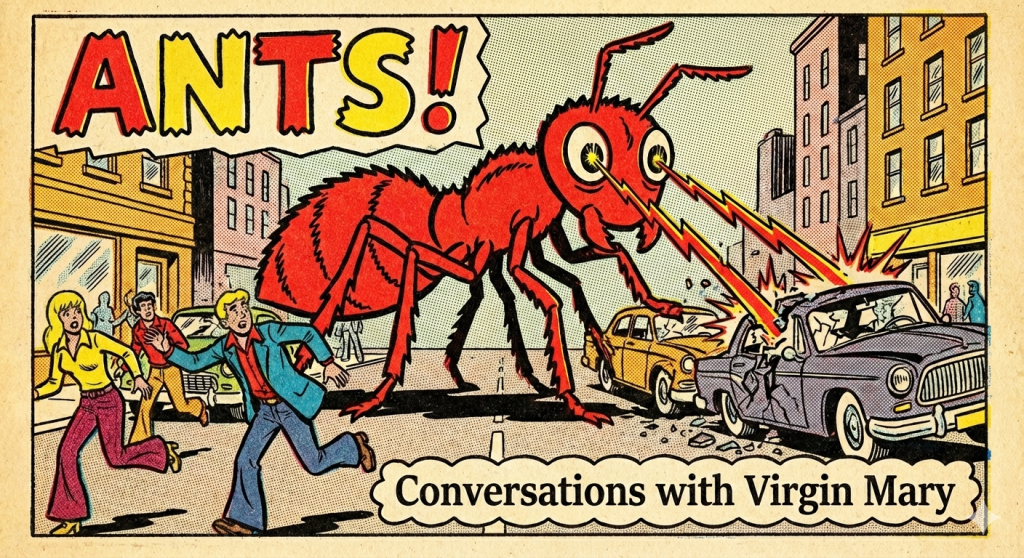
Conversations with Virgin Mary
Before taking my flight to Mexico, I stopped by Jorge’s house with a bottle of maple syrup. Nothing more Canadian than maple syrup. No alcohol for the holidays—I know Jorge doesn’t like to drink. I used to give wine or spirits to friends at Christmas, and this amber bottle looked similar enough, at least from a distance.
I wanted to knock, but there was an envelope with my name hanging from the doorknob. It was one of the Letters from Virgin Mary, along with a note from Jorge: “Sorry I missed you. She told me you would come before leaving for Guadalajara. Have a safe trip. Merry Christmas.”
So I left the bottle at the front of his house with a card. Virgo, the cat, appeared as I arrived, meowed once, and disappeared. Then I drove to the airport.
Thursday, January 1st
Ants—you see them walking in lines, one after another. It looks like obedience, as if they’re following a leader or simply copying the ant in front of them. But that’s not what’s happening. Ants don’t follow leaders. They follow pheromones—a chemical trail left behind by thousands of ants before them.
Each ant deposits a small amount of this scent as it walks. The more ants pass, the stronger the trail becomes. It is not vision that guides them, but chemistry. Not intention, but accumulation. Often it is not the most efficient path, but the one traced by their ancestors. They don’t choose it. It’s programmed for survival.
Now watch what happens when that invisible trail is erased. Break the line with your finger. Disturb the ground. Interrupt the scent. Suddenly, there is chaos. The ants hesitate. They circle. They scatter. Even though they can still see one another, they no longer know where to go. The path is gone, and without it, movement collapses into confusion.
Sometimes we behave exactly like that.
We move forward because a path already exists—left there by our ancestors, reinforced by repetition. We follow the trail, the signs, the smell of certainty, without knowing where it leads or why. The instruction is simple: follow. We mistake obedience for direction.
But we forget something essential.
We are not ants.
We are capable of erasing the trail. Of stopping the search for the scent left by others. That instinct—to follow blindly—is ancient, almost savage.
Listen carefully.
You are not lost just because you deliberately erase the trail. You are not wrong when you refuse to follow a path that no longer makes sense. Our ancestors gave us roles to play, and sometimes the bonds are so strong they feel impossible to break. But you do not need to follow a path simply because it exists.
You already know where you are going. Keep moving. Walk slowly if you must, but keep walking. This time, you are not following the path.
You are making it.
Be certain of this: the way forward does not exist before you step. It exists because you step. The trail is not behind you.
It is being written under your feet.
On the flight to Guadalajara, I kept thinking about family scripts. The roles we inherit. The paths we follow because someone walked them first.
I’m going to visit my mother for Christmas, and I remember those family gatherings where each of my siblings played a role—assigned, rehearsed, unquestioned. Everyone tried to behave, to stay inside the character they had been given.
There was always the same person cutting the turkey, even though no one really knew how to cut a turkey. No training, no skill—just tradition. Another sibling was always responsible for bringing the romeritos and the shrimp croquettes. Not the best cook in the family, but the designated one. The food was usually overcooked, but that didn’t matter. It was part of the script.
There was also a DJ. A real position of power. He controlled the music, but only within a narrow archive: songs my parents remembered from their own Christmases. No new music allowed. Memory had veto power.
One year, I dared to change the rules.
No turkey. No cooking. I ordered a suckling pig.
My siblings reacted like ants that had lost the trail. Confused. Unsure how to behave. Watching them lose control was strangely funny. In the end, it was one of our best gatherings—freer, lighter, stripped of assigned roles. People relaxed. They enjoyed the reunion without performing it.
Why do we have to follow the path laid down by our ancestors? Why insist on repeating the same meal every Christmas when nobody actually knows how to cook it? Tradition, in that moment, felt less like heritage and more like inertia.
This Christmas will be different. No full family gathering. Just my mother and me. My brothers will be home with their families, assigning roles to their children as expected. But at my mother’s house, there will be no script. No DJ playing my parents’ old songs. No turkey that nobody knows how to carve.
So I’m going to order what she actually likes.
Maybe escamoles—often called “Mexican caviar”: the edible larvae and pupae of the Liometopum ant, harvested from agave roots. Nutty, buttery, with a texture somewhere between cottage cheese and scrambled eggs. Fried in butter with onions, chili, and epazote. Served in tacos or with eggs.
As far back as I can remember, I have been a rule breaker. I refuse to follow a path simply because it is there. At the architecture faculty, when a new project was assigned, you could almost see the path forming immediately among my classmates: the entrance always in the same place, the program following the same rules, the same formal language, the same solutions rehearsed again and again.
I wanted to approach the problem differently. If the project suggested an entrance from the south, I tried the north. I questioned the norm—not to provoke, but to test its limits. Sometimes it worked. Most of the time, it didn’t. But it was the only way I knew how to learn.
My approach to art is the same. I don’t practice hyperrealism to render the perfect figure I use it to describe internal conflict. The drawing is never the point.
Ants instead of turkey.
That’s my way of breaking the path.


 Carlos Fentanes
Leave a comment