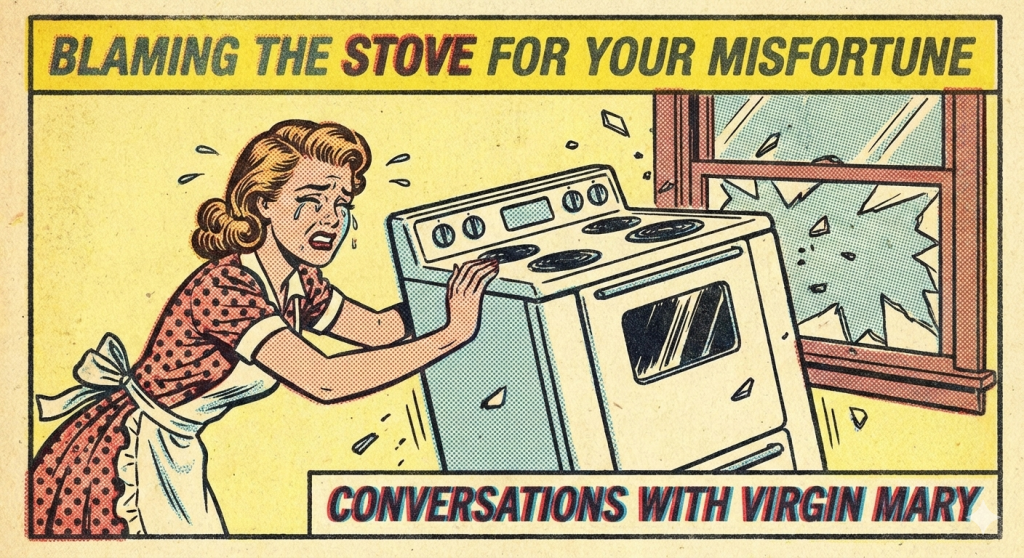
Conversations with Virgin Mary
I arrived in Guadalajara and went straight to my mother’s house. As soon as the taxi dropped me off, a tuxedo cat appeared and meowed at me as if welcoming me.
“Virgo?” I said half-joking.
She meowed again and vanished. Coincidence, probably.
I started to unpack, and inside my laptop backpack I found a folder I hadn’t noticed before. It was from Jorge. Inside, there were three letters.
“Read them when they make sense. You’ll know,” said a note.
How that folder ended up in my backpack, I have no answer.
My mother was waiting for me. As soon as she saw me, she started talking—about the house, the weather, the holidays—everything except her health.
She seemed calmer than the last time I saw her. When I asked about her Parkinson’s, she told me she’s seeing a doctor who has developed a treatment to soothe the symptoms. She said she’s walking again, even going up and down the stairs.
She looked better. More alive. Making plans.
She also had cataract surgery in both eyes recently and now she can see more clearly. Maybe that, too, is helping—her mood, her desire to move. I had never realized how much vision could affect health. I read later that clearer vision can lift mood and even ease some physical burdens.
But I noticed something strange in the first days.
One of her granddaughters came to visit—my former sister’s daughter—and almost immediately my mother’s mood changed. From calm to sadness. She began to cry, to talk about my father. Her Parkinson’s symptoms resurfaced. She complained of pain in her shoulders, as if my niece’s presence had triggered something inside her.
My niece was Grandpa’s pet, my father’s favorite granddaughter. And she’s also my goddaughter—a role I accepted despite not being a believer, because family bonds sometimes matter more than faith. But after family fights between my father and her mother, the relationship with the granddaughter began to cool, and that fracture seemed to trigger my father’s rapid decline.
I know my niece is not to blame for her mother’s behavior. She always took care of my dad and my mom. But maybe to my mother, my niece’s presence is a reminder of everything broken with her daughter—my former sister. The love is real, but so is the grief.
I wondered if what Jorge has been saying is true—that by changing the mind, the body can heal, or at least ease its symptoms. But if that is true, then the reverse must also be possible: the body can get sick when the mind is disturbed.
When my niece left, my mother asked me to bring her some photo albums. She started talking about the past—old places, old friends—and her smile returned.
I don’t know exactly what I witnessed. In a short span of time, my mother moved from calm to pain to calm again. I know my niece loves her and wants to help. But why does her presence trigger this response? That is a question worth sitting with.
I opened the folder Jorge had hidden in my backpack and started to read the first letter.
Friday, February 5th
When was the last time you really noticed the stove in your home? You take its presence for granted. It has been there for as long as you can remember. Maybe you haven’t changed it in years, maybe not since you moved in. It serves a purpose: it helps you cook, helps you feed yourself and others. It plays an important role in gatherings. You bake sweets there, prepare the Thanksgiving turkey, or whatever replaces it at Christmas. In some cultures, it is the center of the home—the heartbeat.
Do you know it is also the place where most domestic accidents occur? It causes burns, illnesses, even deaths. How is it possible that the same tool that brings comfort and pleasure can also be a source of pain?
What should you do then? Get rid of the stove? Blame it for your misfortune? Remove it from your home?
That would be nonsense. You need it close to you, even knowing there will be accidents, even knowing it can hurt you. What you need is not distance, but understanding. You need to learn how to use it, how to respect it, how to take precautions. That’s how accidents are avoided—not by eliminating the source, but by learning how to handle it.
The same is true of family.
You will be hurt by family members. Most wounds between people happen within families, between partners, between those who are close. That cannot be avoided. But it is also within family—within intimacy—that healing, support, and solace are found. Don’t throw your family away just because they can hurt you. Yes, they will. But they can also heal you.
I have a task for you this week. I know there are family members you haven’t seen in a long time because of conflict. I’m not asking you to contact them. I’m asking you to write about why you created that distance. Perhaps then you’ll see that pain is often the result of a mishandled moment, not the essence of the relationship itself.
I will send you a messenger to help you remember what family is.
I thought about Jorge’s sister—twenty years of estrangement, one email that could have burned him. He chose not to respond. Was that avoiding the stove entirely? Or was it learning not to touch the hot surface?
Thinking about the Virgin Mary’s task in the letter led me to my own former sister. We haven’t spoken in a long time. The task was to write about why I created that distance. I wasn’t ready.
But watching my mother react to my niece’s presence—seeing how family proximity can trigger pain even when both people mean well—made me wonder whether I had been using distance as protection. Not from cruelty, but from the heat of unresolved conflict.
Later that evening, I began researching. Can emotional states trigger Parkinson’s symptoms? Can stress caused by family presence worsen tremors? The medical literature was inconclusive, but it did suggest that stress hormones can affect motor control.
Jorge had said that he had “tamed” his Parkinson’s by changing his mindset. Maybe what I witnessed was not mystical at all—just a body responding to emotional temperature. My mother near my niece: stress, symptoms. My mother with photo albums: calm, relief.
That afternoon, after going through the photo books, my mother gave me a missal that had belonged to my grandmother—my father’s mother. It dated from 1898, more than a century old. Inside were faded photographs, holy cards with prayers, and a letter. The letter was written to my great-grandmother by her nephew. He explained why he had not written sooner: he had been overwhelmed by work and by caring for his own dad. His days ran from eight in the morning until eight at night. Only now, with a few free days, did he finally have the time to write.
The next morning, I read the letter again. His days ran from eight in the morning until eight at night. I understood. I had been here only two days and already felt the weight—the constant vigilance, the need to measure emotional temperature at every moment.
My mother has help, so most of the time I am here only as an observer. Still, I can understand the burden. I lived something similar years ago, taking care of my own brother while attending university at the same time.
A distant nephew. A caretaker’s exhaustion. A letter written only when time finally allowed.
The stove is not the problem.
The question is whether we can learn to cook without getting burned.


 Carlos Fentanes
Leave a comment