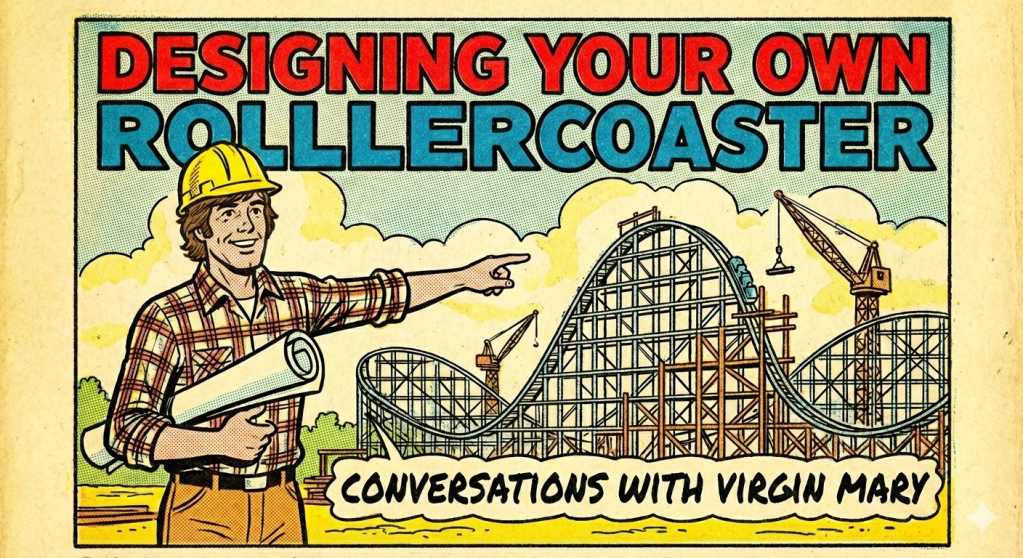
Conversations with Virgin Mary
Thursday, July 31
A roller coaster never begins the way you expect.
At first, it moves slowly—almost politely. A gentle glide, like a reconnaissance round through open fields. You take it all in. You notice the sky. You feel safe. Then the cart starts to climb. Higher. Higher still. The rails narrow. The ground disappears. Suddenly, everything stops—or at least it feels that way. All you can see is blue sky. No tracks. No horizon. Just suspension.
And then gravity takes over.
The cart drops. Free fall. A curve. A spiral. Sharp turns you didn’t see coming. Ups and downs so fast there’s no time to calculate what’s next. Everyone screams. Adrenaline replaces thought. You waited hours for this moment, and now that you’re in it, a strange question appears: When does this end?
It’s contradictory—and completely familiar.
Have you ever felt that you weren’t in control of what was happening to you? As if some external force was pulling you toward a destination you didn’t choose? Like riding a roller coaster you don’t remember boarding?
Life moves the same way. There’s the slow beginning. The climb. The moment when everything seems to pause in slow motion. And then the rush—the part where you realize you have no control at all.
This isn’t metaphorical. It’s not fantasy. Everything was planned before you were born.
Before arriving here, you traced your route. You designed your own roller coaster—every curve, every peak, every sudden drop. You are the architect of your own amusement park, living inside it every day. And of course it isn’t boring. You didn’t design it to be. You built unexpected turns, moments that feel like falling into the void, drops so close to the ground you’re sure you’ll crash.
Change is the only constant. Uncertainty is guaranteed.
Knowing this—does it make you calmer? It may feel like it hurts while it’s happening, but when the ride ends, you realize you survived. More than that: you are different. You grow.
Suffering is not punishment. Suffering is embedded in the track itself. It is part of the design. Every uncertain turn, every corkscrew, every loop that turns you upside down is frightening—sometimes painful—but necessary.
There is a task I ask you to perform this week.
I am not asking you to ride a roller coaster. I am asking you to be present.
Each time your thoughts begin to unroll—each time you start predicting outcomes, telling yourself if I do A, then B will happen—stop. That is the ride running ahead of itself. That is expectation pretending to be control. Let it go.
Do not anticipate the fall. Do not rehearse the curve. The ride will happen whether you imagine it or not.
For one week, remain in the moment. No expectations. No conclusions. When a situation arises, do not attach yourself to it. Observe it, and let it pass.
You will recognize my messengers when your mind begins its own ride again. They will appear as reminders: a train, a rail, an image of an amusement park. You will know when you receive them.
Relax.
Enjoy the ride.
I came to Guadalajara with a single goal: to stay close to my mother. This wasn’t a nostalgic trip. I wasn’t there to see old friends, visit museums, or wander through shops. I was there to be present.
Our mornings followed a rhythm. A light breakfast—coffee and bread, sometimes cookies or jelly. Then she reached for her iPad and began greeting the world: her children, her sisters, friends. Facebook reels followed. Then the nurse arrived to help her bathe before real breakfast.
Eggs. Bread. Orange juice. Sometimes beans. One morning, I walked a block to the menudería and brought back menudo—a red chile stew made from beef tripe and hominy, topped with lime, onion, cilantro, and oregano. Believe it or not, this is a traditional breakfast in Guadalajara.
After eating, we had time. And that’s when the conversations happened. I was there to listen.
One day, without prompting, my mother began to talk about my father.
It wasn’t a fairy tale.
There was resentment—layered, unresolved. Living for more than sixty years with someone who is mentally ill is not simple. Uncertainty becomes routine. You never know how the next day will unfold.
She began with his last days. How he spoke about not being the best father. How he asked for forgiveness. How he said he was sorry.
I was about to talk about my own experience when something stopped me.
We were seated at the dining table. In front of me, inside the china cabinet, was a small salt-and-pepper set shaped like a roller coaster car. I hadn’t noticed it before. I don’t remember seeing it there at any other time. A small metallic cart, two compartments, the shakers sitting side by side like passengers locked into their seats.
I said nothing.
I stayed silent. The feeling was mixed—part interruption, part warning.
I remember my father angry at every celebration. Christmas. Birthdays. New Year’s. Weddings. Sometimes he wouldn’t speak to us. Sometimes he wouldn’t eat with us. Christmas dinner, in my memory, was never calm—only fighting, silence, irrational rage.
I wanted to ask my mother how she held all of this together—how she reconciled those moments—but seeing her condition, hearing her tell her story, I stopped myself. I didn’t come to interrogate the past. I came to listen.
She told me about his infidelities. His mood swings. The times he disappeared from the house. She tried to justify him—he was ill, she said. Bipolar disorder is incurable.
I thought about marriage vows: in health and in sickness. My mother took them seriously. She knew about his illness. She accepted the ride. And now—at the end—she can see the entire track from her cart but she didn’t arrive intact. She’s holding years of repressed emotions.
That night, I called my wife and told her what my mother had shared. She pushed back. She said I was retelling the same story—the one where my father is the villain. She asked me not to label him as the bad guy.
She’s right.
But she never experienced his rage in technicolor.
I think my mother is still riding her own roller coaster. Sixty years of conditioning doesn’t stop just because the ride ends. When everything finishes abruptly, the body keeps moving. The memories keep running. Like software programmed over decades, still executing commands long after the machine should have shut down.
That kind of program is hard to interrupt.
When I moved to Canada, I tried to leave the past behind. I called my parents every week, on holidays, but distance changed everything. I was outside the damage zone. My perspective softened. I made peace with my father in small ways—helping him with computers, printing things, fixing what I could, being with him when he needs me, even from a distance. I was trying to stop my own self programmed software that was still running.
I never returned to Mexico while he was alive. Maybe fear. Fear of being haunted by what I left unresolved.
Now I look at my mother and realize this: the violent drops are over physically, but the ride continues internally. The body doesn’t know the danger has passed. I wonder if her Parkinson’s is part of that—what happens when a system trained for survival is never told it can rest.
This is where Virgin Mary’s letters kept silent. These letters are about prevention but not treatment.
They speak of discipline. Of cleaning the house. Of being present. Of exercises, routines, small acts of order. They warn you not to get too close to the flames but they never explain what to do after the fire—what to do once you’ve already been burned.
How to convince your body that the fire is gone? By washing the dishes?


 Carlos Fentanes
Leave a comment