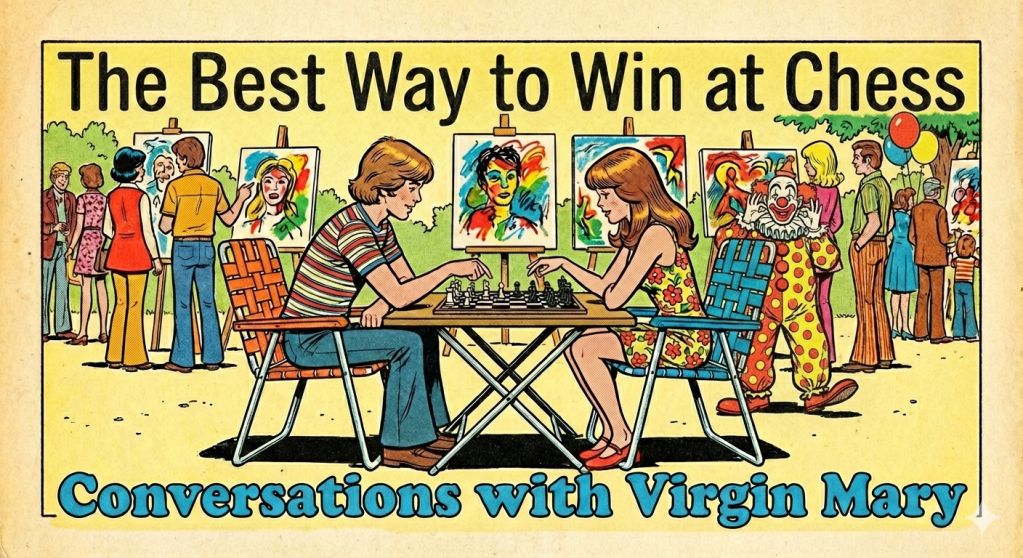
Conversations with Virgin Mary
The snowstorm had passed, and me and my wife started shoveling the snow from the driveway. It took us about an hour to clear the pathway. All the neighbors were doing the same. Some used snowblowers—loud, efficient, impossible to ignore. Most of us, though, relied on the same plastic shovels you can buy at the supermarket for a few dollars.
Once we were done, we had a light breakfast: coffee and pancakes. Shoveling is exhausting in a very specific way. It makes you think slowly. It also made me think of Jorge.
So after breakfast, I grabbed my shovel and walked over to his house to help him clear his driveway.
When I arrived, Jorge was already outside. He was wearing a black winter jacket, gloves, and a fur toque, shovel in hand, talking with a neighbor. He waved when he saw me and made the introduction.
“This is Joseph,” Jorge said. “The owner of Virgo—or at least that’s what he claims, even though I’ve never seen that cat obey any master.”
Joseph was standing beside a gas-powered snowblower, and judging by the perfectly clean driveway, he had already done most of the work.
“Sorry, I’m late,” I said, which felt like the only appropriate response.
After thanking Joseph, Jorge invited me inside for tea.
I followed the now-familiar ritual of the tea ceremony as we talked about the storm, the cold, and the kind of winter that makes everything feel heavier. Eventually, I shifted the conversation to the messengers.
“Something odd happened to me last week,” I said. “I started noticing trains everywhere.”
Jorge looked at me, waiting.
“I was listening to a podcast about a book set in London,” I continued, “and suddenly the host started talking about his daily commute by train. Then I listened to another podcast, recorded in a cemetery in New York, and the speaker talked about a train line running from the cemetery to the shore. Movies, books, songs—everything seemed to involve trains. I don’t know if it’s a messenger, or if I’m just learning to pay attention. Maybe the signals were always there, and I just never noticed them before.”
Jorge listened carefully and answered almost immediately.
“They are messengers,” he said. “They’re there to make you aware of the moment. To make you aware of the message. She’s on a bullet train—don’t you see?”
“I don’t know,” I said. “I always try to find a scientific explanation for everything.”
“Well,” he replied, “the message is clear. At least it’s clear to me. You can take it or leave it—but it’s there.”
Then he stood up, went to another room, and came back with a letter.
“Here,” he said. “This will make things clearer. You’ll see.”
He handed me two yellow sheets of paper, filled with his handwriting.
Friday, March 13th
What is the best way to win at chess?
I mean, to truly win.
Let us begin by questioning what winning means, and which rules you accept without noticing. Chess is often treated as an exercise in strategy, domination: conquering territory, defeating the opponent, demonstrating power. To win, you sacrifice your own pieces without hesitation—your pawns, your knights, even your queen—treating them as interchangeable goods in pursuit of control.
At the end of such a game, the board is a battlefield. Your kingdom survives, but diminished. Your opponent is annihilated. Their king and queen are taken as trophies.
I ask you: how can this be called a victory? It is the butcher’s Sunday triumph, praised as strategy.
Consider another approach.
Think instead of balance. Of restraint. Of taking only what you need.
You do not need two queens when one is enough. You do not need to conquer the entire board to exist upon it. Harmony does not require excess.
What would this look like in chess?
Imagine a game where neither side seeks domination. The board is shared. Pieces move with intention, not hunger. Nothing is taken unless it is necessary. Even more: the players might agree to improve the terrain itself, to build rather than destroy, expanding the board beyond its own limits. The board becomes not a wasteland, but a place of prosperity.
Do not take what you do not need merely to prove that you can. In doing so, you risk losing what is most precious.
You may say that’s not the aim of the game, that sounds boring. Where is the excitement?
But understand this: the greatest things are built through what you call boring—through patience, fairness, and equilibrium—not through conquest.
This applies beyond chess.
To countries.
To companies.
To families.
The more you try to win at all costs, the more you must sacrifice. And the rewards will never equal what could have been preserved through balance.
For your task this week, play a game of chess. With a friend if possible, though a computer or an app will also do. As you play, notice what is required to win. Notice how often victory demands harm—not only to your opponent, but to the relationship itself.
If you play with a friend, you will feel this more clearly.
When you have completed this task, I will send you another messenger. It will also involve chess.
Stay attentive.
Listen to your surroundings.
“So, your turn—what’s your next move?” Jorge said after I finished reading the letter.
“I never thought about chess this way,” I replied. “I used to play every weekend with a friend. He once invited me to sell my paintings in a park in Guadalajara. He had a lot of faith in my work. I must have been twenty-two or twenty-three. He invested in frames, loaded his truck with my paintings, and every Sunday we laid them out in the park. While we waited, we played chess.”
I smiled at the memory.
“We never sold anything. Well—almost never. In six months we sold one painting. That day we were so happy we went to a bar and drank a couple of beers to celebrate.”
That was just after I left the Architecture Faculty, when I was testing the waters of being an artist. I knew nothing about the art world, nothing about how to sell a painting. I met a few artists there; I’m still in touch with one of them.
“There was a clown,” I added. “Every Sunday he sold out completely. He was the hit of the park. And yes—he was an actual clown. He also worked at children’s parties. He made small, colorful drip paintings. He didn’t care about art or messages. For him, it was simply a way to make a living.”
While I spoke, Jorge listened quietly. He took out an old chess set from a leather case. The pieces were bronze and heavy. Slowly, deliberately, he began setting up the board.
When I finished my story, he asked me to choose a hand—black or white. I chose, and got black. He opened the game with white.
It had been a long time since I last played. At first it was difficult, but as the game unfolded, I started gaining ground. I took most of his pieces. He captured many of mine as well. By the end, I had the advantage: a rook, a knight, and a bishop. He was left with a bishop and two pawns.
“And checkmate,” I said, cornering his king.
Jorge smiled. He pointed at the board.
“You see what the Virgin Mary is talking about?” he said. “Look at the result. See what you had to sacrifice to conquer the board. Now what? You’ve won—but your opponent hates you. Are you happier? Are you better? This is a wasteland. You don’t have enough pieces left to rebuild what you destroyed. And there’s no way back to the beginning.”
I knew he was right. Still, a question lingered.
“Then why play at all?” I asked. “Who invented this game, and what did they have in mind?”
Jorge looked at me and said, calmly:
“It’s only a game. But games are how children learn. So—what did you learn from this one?”


 Carlos Fentanes
Leave a comment