Conversations with Virgin Mary
That morning, as usual, I was scrolling through Instagram in search of art calls—my version of checking the classifieds—when a peculiar reel appeared in my feed. It showed a chess match between Bill Gates and Magnus Carlsen. Fast chess. Seventy-nine seconds. Carlsen dismantled Gates with surgical efficiency. Gates lost. Carlsen didn’t. Not a single piece.
No drama. No cruelty. Just inevitability.
I watched it twice. Then I thought of the last letter from the Virgin Mary—The best way to win at chess. I wondered, briefly, whether her argument would survive contact with someone like Carlsen. Whether you could invite him to build instead of destroy. Whether you could negotiate harmony before the massacre began.
Probably not.
Since beating Jorge at chess, the game no longer looked the same to me. Something had shifted. The board felt exposed, almost embarrassing. Like seeing the scaffolding behind a building you once admired.
I started to suspect that Jorge had let me win. That the whole match had been a setup, a lesson disguised as a victory. When I saw him again, I decided to ask directly.
“Did you let me win?” I said. “Were you teaching me something?”
Then I stopped mid-sentence.
“Wait,” I said. “I smell tamales.”
It was sunny outside, but winter sunlight is decorative—it doesn’t warm anything. We were still well below zero. Jorge pulled two pouches of atole from the counter, a thick Mexican drink made of corn starch and milk, and began to prepare it with the calm authority of someone following a law older than himself.
“Today is Candlemas,” he said. “The calendar mandates tamales and atole. No negotiations.”
I pressed him again. About the chess. About the lesson.
“I’m nobody to lecture you,” he said. “You beat me in a real game. Stop assigning intentions where there are none. The Virgin Mary chose you. I just follow instructions. How could I teach you something I don’t know how to teach myself?”
He shrugged, as if that settled it.
“You’re welcome here anytime. You can think whatever you want about me. But I’m telling you the truth.”
Then he paused, turned, and handed me the correspondent letter.
“But before you came,” he said, “she asked me to give you this.”
two yellow pages, handwritten.:
Saturday, December 28th
Laundromat
Your clothes are intimate. You don’t walk around displaying your dirty laundry, and you don’t inspect other people’s stains either.
A basket of dirty clothes is not a confession—it’s a condition. Everyone has one. That’s why the laundromat exists. It’s a strange kind of community center, built around a universal problem no one needs to explain.
Doing laundry is solitary labor. You don’t share machines. You don’t want strangers rummaging through your socks. You come to be alone. And yet, inevitably, you meet others. If you return often enough, you begin to recognize the same faces, repeating the same small rituals. A nod. A wave.
You develop your own routine: the detergent you trust, how you separate colors, the order of things. You do it in silence, almost ceremonially. Like washing dishes. Like meditation. These small chores anchor you in the present. They give your hands something honest to do.
The hum of the machines becomes a mantra—repetitive, steady. Occasionally a dryer stops or a washer beeps and pulls you out of yourself. You look up and see someone struggling with the controls. Maybe it’s his first time. He reads the buttons carefully, closes the door, presses start. The machine comes to life. He smiles, relieved, sits down, scrolls his phone. Minded. Occupied. Contained.
The laundromat is a modern meditation hall.
Rule one: Don’t tell anyone how to wash their clothes.
Don’t lecture them about colors or cycles. Mind your own load.
Rule two: Don’t ask for advice you don’t need.
Learn your own machine. Press your own buttons.
Life often looks like this place. Everyone focused on their own spinning drum, convinced others are doing it wrong, convinced their machine is superior. But no two loads are the same. No two stains come from the same mistake. Advice rarely fits, even when well intentioned.
Your task is simple. Enter. Load your clothes. Wash them. Fold them. Leave.
Do not comment on someone else’s laundry while yours is still dirty.
Do not criticize the world from the waiting bench.
Order your clothes first.
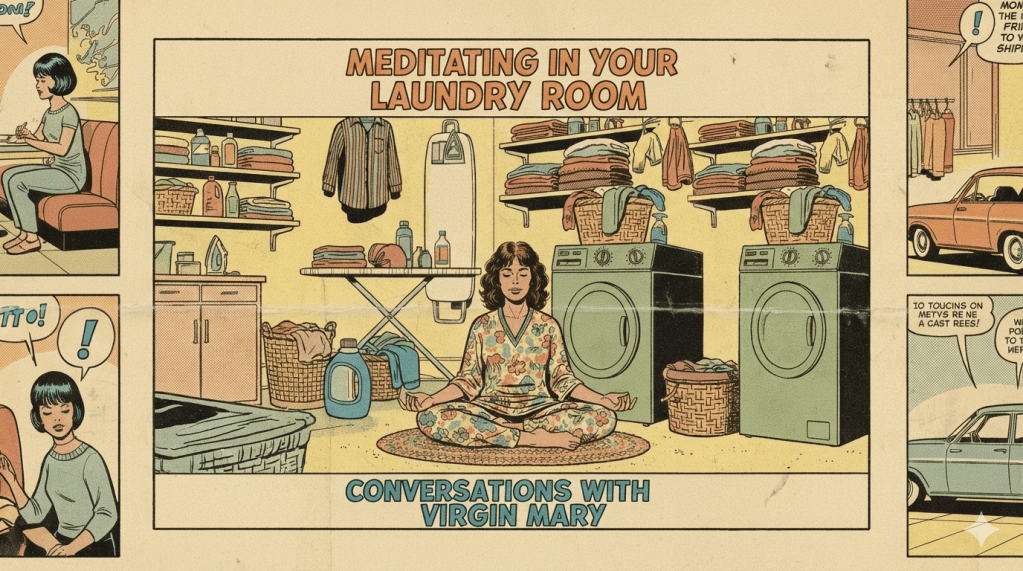
Your task this week will be a meditation using the noise of a dryer as mantra, it can be your own dryer at home but there are also a lot of videos in YouTube of the noise of a dryer or a washer machine, you can use them too, no restrictions.
As usual, once you performed the task, my messenger will come in the form of laundry and it will guide you more in your meditation, be aware of it.
When I finished reading, I looked up at him.
“Meditating to the sound of a dryer?” I said, halfway through my first bite of tamal. “Are you serious?”
He smiled.
“Did you know the sound of a dryer helps babies sleep?” he said. “This isn’t arbitrary. It’s science. You should try it at least once in your life. It’s miraculous.”
His voice was soft. His eyes unfocused. Jorge was entirely present and, at the same time, clearly somewhere else—like a man relaying information from a room I couldn’t enter.
“Again,” he said, “you don’t have to believe me. Do the work or don’t. Live your life.”
Then he leaned forward.
“But think about how you were when we met. You thought this was a prank. You didn’t believe in the letters. You were convinced I was writing them. Compare that to now.”
He paused.
“You’re different. Better. Calmer. More decisive. Even your mother—hasn’t she improved?”
He raised his hands in front of me. They were steady. No tremor.
“Are you going to tell me I still have Parkinson’s?”
I thought of my last video call with my mother. He was right. She had been still. Not frozen—but settled. It was impossible to believe that reading letters and folding laundry could affect neurodegenerative disease, or open doors in the art world. And yet, something had changed. I had changed. Small adjustments. A tightening here. A release there.
“I don’t know how this works,” I said. “But I’ve changed. That’s why I keep coming back. There’s something about this place. About you. It feels like possibility is allowed here.”
Jorge nodded.
“Don’t think,” he said, finishing the last bite of his tamal and draining his atole. “Just be present. That’s the task. I hope you can find pleasant the sound of the tumble dryer”.


 Carlos Fentanes
Leave a comment