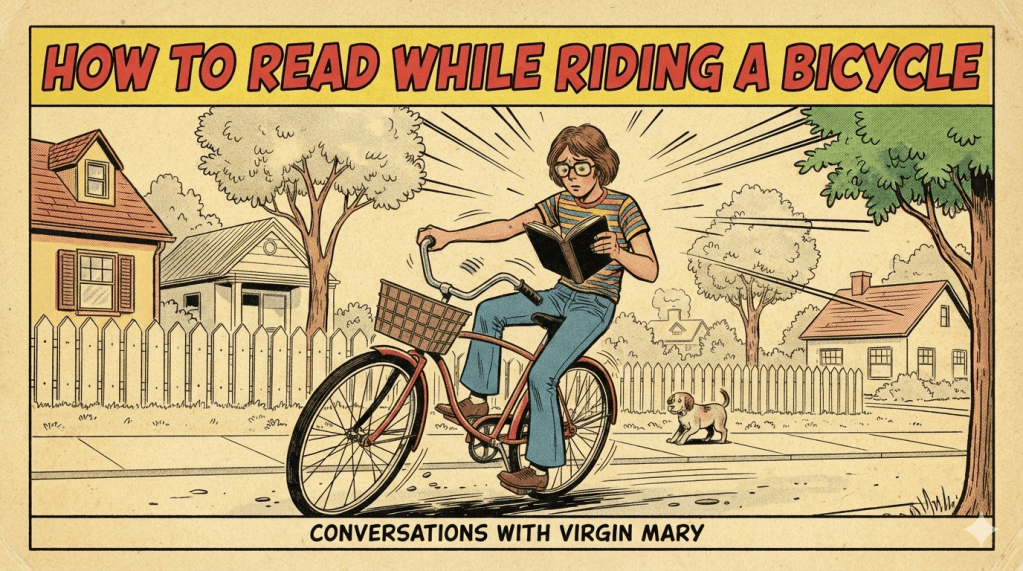
Conversations with Virgin Mary
Thursday, January 31st
Sometimes you will find yourself with this paradox, how can I learn to do something that need all my attention? how can I read a manual and perform the task at the same time?
Bicycles don’t come with instruction manuals.
Neither does life.
The instructions for riding a bike are simple:
Grab the handlebar.
Look at the road ahead.
Decide where you’re going.
Start pedaling.
Your sense of balance will do the rest.
Will you fall? Yes.
Will it hurt? Yes.
But don’t worry about that before it happens.
Just pedal.
If you fall, you get up.
You mount the bike again.
You repeat the steps.
Do you need a manual for that? No.
Do you need a warning label about pain? Optional.
Pain is part of learning.
It’s good to wear a helmet.
It’s good to follow road signs.
But no one learns by reading.
You learn by doing.
By trying.
Now imagine a manual that explains everything in technical detail:
Grip the rubber handles located at each end of the handlebar.
Place your right hand on the right handle and your left hand on the left handle.
Note the presence of two levers: one for gears, one for brakes.
Do not confuse them.
Refer to the diagram…
Now imagine trying to read that while riding.
You would need a second manual:
“How to Read an Instruction Manual While Riding a Bicycle.”
That manual would explain how to read the first manual
so you could finally learn how to ride.
Absurd.
There is no manual for living either.
You grab the handlebar.
You start pedaling.
If you fall, you fall.
You get up.
You try again.
Will you get hurt? Yes.
Is there another way to learn? No.
So go outside.
Ride with your friends.
Go to the park.
Try tricks.
Come home with scrapes and bruises.
That means you lived.
That means you tried.
That means you failed.
That means you got back up.
That means you learned.
Your task this week: ride a bicycle.
Go outside.
Take a real ride.
Notice what changes.
Your messenger will come in the form of a bike.
Pay attention to your surroundings.
“Are you telling me the diesel warning bill is still sitting on your desk?” I asked.
“For months?”
“I thought you had already sent it.”
Jorge didn’t answer immediately.
“I’m paralyzed,” he finally said. “I don’t know what to do. I know my MP will throw it straight into the trash. I don’t want my work to end there. There has to be a better place for it—somewhere it can breathe before it dies in a politician’s inbox.”
“I’ve been submitting work my whole life,” I said.
“Art, writing, proposals. I know one thing for certain: I’ll be rejected more than once. I’ll fail. I’ll fall. That’s guaranteed. The only real choice is whether I get back up or stay on the ground.”
“Some people stay on the ground,” I continued. “It’s safe there. You can’t fall if you’re already down. But I decided to stand up again. And again. Eventually something happens. A gallery answers. A venue accepts a piece. A magazine publishes an article.”
That was the first time I saw Jorge frozen.
Not confused—stuck.
So I moved.
“Let’s see what we can do,” I said, putting the kettle on the stove.
“Where do you keep your teas and herbs?” I asked, pretending I didn’t already know.
“Let me do it,” he said, standing up. “You don’t know what I have. But you can check the computer—my proposed bill is there.”
I scanned the document.
“You need allies,” I said. “Environmental groups. Institutions. Not politicians first. Try Greenpeace. The Suzuki Foundation. Organizations that know how to carry ideas forward. Don’t go alone.”
He looked unconvinced.
“They’ll laugh at you,” I added. “Not because the idea is bad—but because they won’t know what to do with it.”
The kettle whistled.
“I called you because I didn’t know what to do,” Jorge said. “It’s my first time doing this. I ran out of ideas. I know your world—submissions, rejection, failure. I thought you could help. Be my partner in crime.”
He poured hot water into two cups.
“What is this?” I asked.
“Darjeeling,” he said.
“A premium tea from the Himalayan foothills. High altitude. Spring harvest. Floral notes. Real Darjeeling doesn’t exist in supermarkets. What they sell there is a replica.”
He placed the cup in front of me.
I didn’t need to drink it to know it was different.
The aroma alone altered the room—changed the weight of the air, the color of the space.
“It’s special,” I said. “I haven’t tasted anything like this in years.”
Then he handed me the letter.
The one about reading while riding a bicycle.
After I finished, I looked at him.
“There are plenty of scams online built around the art world,” I said.
“People selling formulas, secrets, codes. I once saw a guy selling a book about how to get accepted by galleries. He claimed he had cracked the system—said he’d sent hundreds of letters and discovered the method. The strange part? He was an unknown artist, with no gallery representation, no visible career, no institutional presence—selling an instruction manual for something that hadn’t worked.”
I paused.
“I’ve done it myself. I have a project on my blog called 100 Days, 100 Galleries. For one hundred days I contacted galleries around the world. Some answered. Most didn’t. That’s the reality. There is no secret code. No hidden formula.”
“There’s no manual for sending a bill to an MP,” I said.
“No manual for proposing a law.
No manual for submitting art.
No manual for changing a system.”
“You just pedal,” I said.
“And fall.
And get up.
And pedal again.”
“That’s my life.”
Jorge shook his head.
“What I have is fear,” he said.
“Fear of being ridiculed.
Fear of being wrong.
Fear of proposing something impractical.”
“I’ve been an engineer my whole life. My thinking is about efficiency, not disruption. Not putting obstacles in systems. Not complicating industries. This idea goes against everything I was trained to do.”
He paused.
“And yet it’s a good idea. It could push progress. It could change transit policy. But I don’t know how to carry it.”
“You submit it,” I said.
“And you expect rejection.
If you expect disappointment, you’re never surprised by it.”
“And if it fails,” I added, “we find another door. Another group. Another path. There’s always another way forward.”
I took another sip of tea.
“We’ll pedal,” I said.
“And if we fall, we fall.”
“But we don’t stay on the ground.”


 Carlos Fentanes
Leave a comment