Conversations with Virgin Mary
Tuesday, February 17
This letter will be different from my previous lessons. This isn’t about messengers or tasks. I need you to understand the process to become, to be transformed, to see why you’re here. Life is full of ingredients. Every event, every moment, is like an ingredient in a meal. Each one has its role in the final product. Let me make this easier.
Life, in a way, is like cookies. You can buy them at the supermarket, or you can bake them yourself. And when you bake them, you can just follow a recipe, or you can try to understand each ingredient, what it does, and why it matters. I recommend the second. Your life is too precious to trust anyone else with it, to unwrap someone else’s version of the cookie and call it yours.
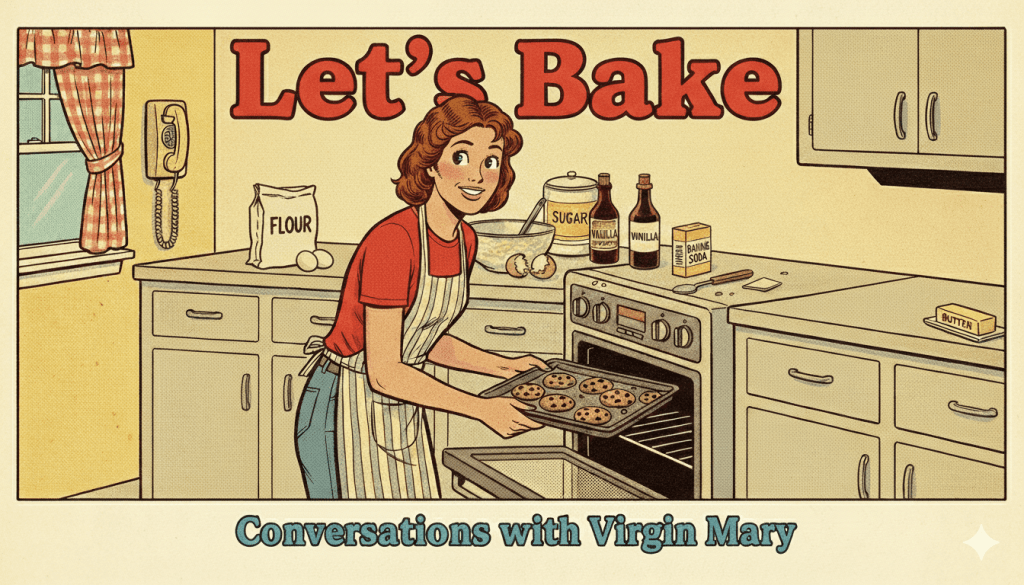
So, let’s bake.
You start with two worlds that don’t meet until the very end: the wet and the dry. The wet world begins with butter. Cut it into small chunks and let it sit for a while. Not too cold, not melted — just soft enough to bend, to change shape, to promise structure without losing form. Butter at this stage is like potential. It doesn’t know what it wants to be yet.
Then comes sugar. The crystals are tiny, sharp little explorers. They carve caves into the butter and trap air. Suddenly, what was soft and chaotic becomes a skeleton, invisible but firm. The butter and sugar whisper to each other: “We can hold this together. We can support more.” This is not cooking. This is micro-architecture. It’s patience, it’s negotiation, it’s learning how unstable things can hold each other up if given the right environment.
Next arrives the yolk. Bright, slick, full of proteins, fat, and water. It doesn’t just mix in. It negotiates with the butter and sugar, telling them how to work together. It promises color, cohesion, and loyalty when the heat arrives. Vanilla, on the other hand, doesn’t care about structure. Vanilla whispers, it signals: “Pay attention. This is going somewhere.” You do. You smell it. You understand it.
Now the dry ingredients assemble like a jury. Flour is the quiet one. It doesn’t shout or build castles. It absorbs, it holds, it gives fragile walls to a liquid world. Baking soda is the trickster, waiting, patient, ready to explode. It will puff, stretch, and lift the dough when the heat arrives. Salt, ever the mediator, does not shout. It balances, tunes, and sharpens perception. Without it, the structure sags. Without it, flavor dies.
And then—the chocolate chips. Ah, the chocolate chips. They are not passive. They soften, melt, migrate, and then recrystallize. They bleed flavor, texture, and fat into the dough. They change themselves while changing the cookie. Sweetness, bitterness, aroma — all interweaving in secret, invisible work. They are chaos guided into delight, tiny alchemists performing transformations right under your nose.
Finally, the oven. Heat arrives like a strict teacher. It melts, expands, coagulates, gelatinizes, browns, and locks. Air trapped in the sugar-butter lattice inflates like tiny balloons. Egg proteins unfold, then knit together. Flour swells, sugars caramelize, Maillard browning whispers its promise of golden edges. Water migrates outward, leaving crisp edges and a soft center. You started with disorder, and now you have a cookie that stands on its own.
You could buy these cookies pre-packaged. Perfect. But you would never know the negotiations, the tiny explosions, the migrations and transformations inside the dough. Chemistry isn’t just a formula — it’s a story. It unfolds in real time, visible in texture, aroma, color, and taste.
Baking cookies teaches something larger than cookies. Chaos, when guided, can form itself into something unexpectedly wonderful. You learn patience, observation, care, and timing. You learn that attention to detail transforms not just dough, but life.
And that is why we bake: not just to eat, but to understand.


 Carlos Fentanes
Leave a comment