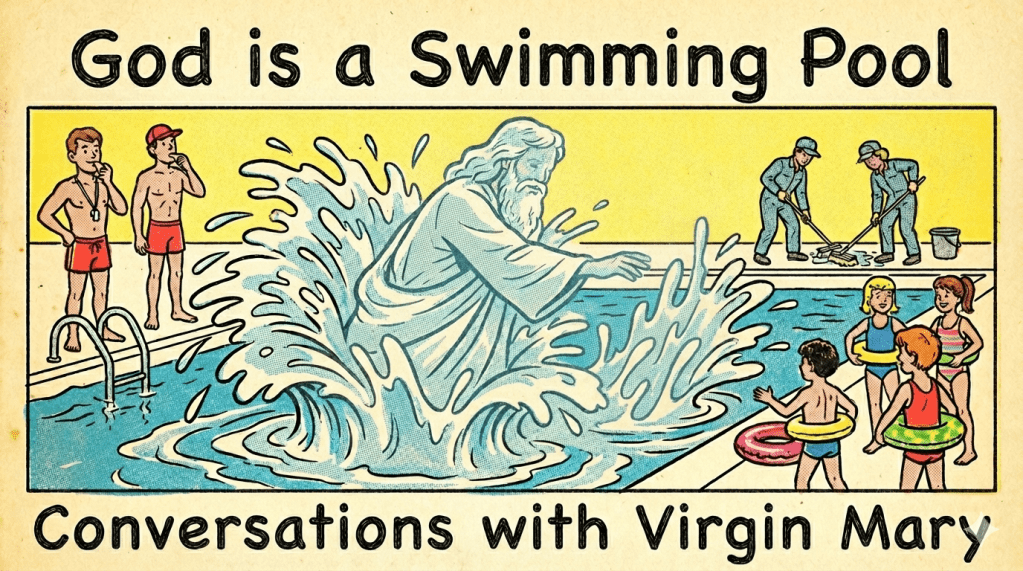
Conversations with Virgin Mary
“Come, come—look at this.”
Jorge opened the door already smiling, already halfway into his excitement. In his hands was a small copper object that looked like a cross between an espresso cup and a laboratory instrument—an elongated handle, a narrow neck, perched over a flame like something borrowed from a chemistry lab.
“What is that?” I asked. “Are you running experiments in your kitchen now?”
He laughed. “It’s a cezve.”
“A what?”
“The Turkish way of making coffee,” he said, waving off my suspicion. “Relax. You don’t need to convert to drink it.”
He set it down carefully, as if it were fragile or sacred—I couldn’t tell which—and began the preparation without commentary, the way people do when they’re doing something they’ve done many times and don’t feel the need to explain. He ground the coffee impossibly fine, almost to dust, poured water into the copper pot, stirred slowly, deliberately, like he was trying not to disturb the air itself. Then he placed it over the flame.
We didn’t talk.
We just watched.
The surface began to rise, dark and glossy, like something waking up. He removed it from the heat, waited, returned it to the flame. Again. And again. Three times, always just before it could boil over—like stopping chaos at the edge of spilling into disaster.
Finally, he skimmed the foam and poured the coffee into two small cups.
The aroma was bright and unexpected—fruity, almost floral. The taste, though, was sharp, dense, uncompromising. My face betrayed me immediately. Jorge noticed and smiled, the kind of smile people have when they know exactly what you’re feeling and are enjoying the process anyway.
“It grows on you,” he said.
It did. Slowly. Not comfortably, but honestly.
When we finished, he told me to turn my cup upside down and let it rest. A few minutes later, he lifted it and stared into the dark stains left by the sediment, studying them with theatrical seriousness.
“You’re anxious,” he said. “About politics.”
I laughed. “I don’t see anything. Just coffee.”
“But you are anxious,” he insisted. And, inconveniently, he was right.
I told him what had been sitting in my head: how the country felt split in two, how everything had become a contest between identities instead of ideas—Christian values versus civil values, faith versus institutions, belief versus law. Conservatives talking about foundations. Liberals talking about structures. Everyone talking. No one listening.
Jorge turned his own cup over, glanced at it, and nodded.
“Coffee doesn’t lie,” he said lightly.
Then he looked at me. “So where do you stand?”
I shrugged. “I trust institutions more than scripture. Laws are clear. Systems are legible. The Bible isn’t. It contradicts itself. One book says one thing, the next says the opposite. I get lost trying to read it as a manual.”
Jorge smiled—not disagreeing, not agreeing. Just understanding.
“That’s because it was never a manual,” he said. “It was written over centuries. Different authors. Different interests. Different politics. Different needs. Even the Gospels came decades after Jesus died. None of them were witnesses. They were curators of memory.”
He paused.
“You don’t have to decode it,” he added. “Take what helps you live better. Leave the rest.”
Then he reached into his folder, the one where he kept his notes and papers and strange fragments, and pulled out another letter from Virgin Mary.
“Here,” he said. “This one’s for you.”
Sunday, June 21st
I need to speak to you about God — not as a warning, not as doctrine, not as fear — but as misunderstanding.
God is not a person.
Not a figure watching your steps.
Not an entity counting your mistakes.
Not a judge waiting to punish you for misreading a book.
We made God into a face because faces are easier than ideas.
The Bible tried to explain something too large for language, and in doing so, it became a map drawn by people who had never seen the whole territory. It contains beauty, wisdom, contradiction, fear, poetry, power, politics — all mixed together. It was a tool for another time, another civilization, another way of understanding the world. It served its purpose. That doesn’t make it eternal law.
So let me offer you another image.
Think of God not as a person —
think of God as a realm.
Not a ruler, but a container.
Not a voice, but a space.
Like water in a pool.
You are a fish inside it.
The water does not tell you where to swim.
It does not command direction.
It does not reward or punish movement.
It simply exists — and because it exists, certain things become possible and certain things become impossible.
Gravity works.
Chemistry works.
Math works.
Time moves forward.
Bodies age.
Cells divide.
Energy transforms.
These are not moral rules.
They are structural rules.
They are not good or evil — they are physics.
That is the law of God.
Not commandments but conditions.
Not judgment but structure.
Not morality but reality.
So don’t ask why God allows war, disease, death, suffering.
Viruses exist because nature allows replication.
Hearts stop because biology has limits.
Bodies fail because entropy exists.
None of this is cruel.
None of this is merciful.
It is not moral.
It is not immoral.
It is natural.
We turned God into a bearded man because the human mind needs faces.
We painted Him touching Adam in the Sistine Chapel because symbols are easier than systems.
We imagined hands separating light from dark because stories are easier than equations.
But these were metaphors — not descriptions.
Humanity once turned Justice into a woman with a scale.
Liberty into a statue.
War into a god.
Thunder into a deity.
Dawn into a spirit.
Not because they were literal —
but because symbols helped people understand invisible forces.
God was one of those symbols.
Now you no longer need the face.
You can understand the system.
It’s okay if you don’t treat the Bible as law.
It was written for a different world, under different fears, different knowledge, different limits.
It was a beginning — not a finish line.
Now it’s your turn to build a new understanding of creation, of Earth, of humanity, of God.
Not through obedience —
but through comprehension.
Can I prove God exists?
Yes.
In the fact that you fall instead of float.
In the way food becomes energy in your blood.
In the chemistry that feeds your brain.
In the physics that holds your body together.
In the structure that allows reality to be stable enough to exist at all.
But God does not think.
God does not plan.
God does not judge.
God is.
And you are not separate from it.
You are not outside the pool.
You are not observing the water.
You are inside it.
Formed by it.
Sustained by it.
Made of it.
You are not God as an identity —
but you are part of God as structure.
Because there is nothing else to be made of.


 Carlos Fentanes
Leave a comment