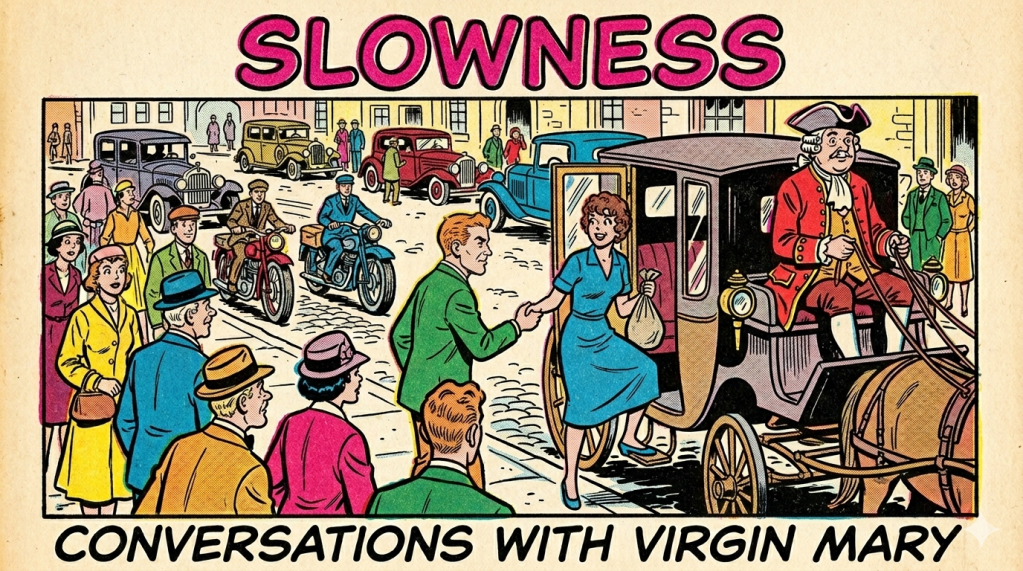
Conversations with Virgin Mary
Jorge didn’t begin with theology.
He began with a child’s toy.
“Let me ask you something simple,” he said.
“A kid buys a ball and a baseball glove for $1.10. The glove costs one dollar more than the ball. How much does the ball cost?”
“Ten cents,” I said immediately.
Jorge smiled. Not triumphantly. Not mockingly.
Just knowingly.
“Do the math.”
I grabbed a piece of paper.
Ball = x
Glove = x + 1
x + (x + 1) = 1.10
2x + 1 = 1.10
2x = 0.10
x = 0.05
Five cents.
I stared at the page.
“I see it. The math is clear. But my brain still insists it’s ten cents. Even now.”
“That’s the point,” Jorge said.
He stood up, opened his pantry, and pulled out a bottle of Macallan. Two glasses. Ice. A slow pour.
“I thought you quit,” I said.
“I didn’t quit,” he said. “I slowed down.”
We sat.
“Your brain,” he said, “has two operating systems. One is fast, automatic, intuitive. It jumps. It reacts. It solves. It feels certain. It exists to keep you alive.”
He paused.
“If a predator appears, you don’t calculate probability. You move. You don’t analyze options. You run. That system is not designed for truth. It’s designed for survival.”
He took a sip.
“The second system is slow. Deliberate. Effortful. Analytical. It calculates. It doubts. It checks. It gets tired. And because it gets tired, it’s lazy. It lets the fast system lead most of the time.”
I nodded.
“And here’s where it gets dangerous,” he continued.
“The fast system doesn’t just produce answers. It produces convincing answers.”
He leaned forward.
“Have you ever fact-checked a political post on social media?”
“Sometimes.”
“All parties do the same thing,” he said. “They don’t sell truth. They sell speed.”
He started listing them, calmly, almost clinically:
“Venezuela’s problem? Maduro. Remove Maduro — problem solved.
Clear.
Simple.
Wrong.
Toronto’s housing crisis? Bureaucracy and migration. Cut government. Cut taxes. Cut migrants. Let the market fix it.
Clear.
Simple.
Wrong.
Name any complex problem — crime, education, inflation, grocery prices — and someone will offer you a solution that feels obvious.”
He paused.
“Not because it’s correct.
Because it’s fast.”
He tapped the table.
“They’re not trying to solve problems. They’re trying to activate your fast system. Because fast thinking votes. Fast thinking shares. Fast thinking reacts. Fast thinking feels like clarity.”
Silence.
“So what do we do?” I asked.
“Stop thinking?”
Jorge smiled again.
“See? That’s another fast answer.”
He shook his head.
“No. You slow down.”
He gestured toward the glass.
“This whisky didn’t happen quickly. Fifteen years. Two kinds of oak. Two climates. Time. Patience. Accumulation. Process.”
He lifted the glass slightly.
“You can’t rush complexity. You can’t microwave meaning. You can’t speed-grow depth.”
Then he said something quietly, almost as if he were speaking to himself:
“Emergency thinking feels intelligent.
But it’s just efficient panic.”
He looked at me.
“Real intelligence is slow.
Real solutions are slow.
Real meaning is slow.”
A pause.
“Sleep on problems. Sit with them. Let them mature. Let them resist you. Let them contradict you. Let them stay unsolved longer than feels comfortable.”
Another pause.
“Immediacy feels productive.
But it’s often just motion without direction.”
He finished his drink.
“Don’t look for emergency exits,” he said.
“Look for architecture.”
“H. L. Mencken once said: For every complex problem there is an answer that is clear, simple, and wrong.”
Tuesday, May 13th
Carriages are time machines.
The moment you step into one, you are transported — not forward in space, but backward in tempo.
Not into another place, but into another speed.
A carriage does not exist to arrive quickly.
It exists to make you feel the distance.
The ride begins the moment you step inside.
Not when you arrive.
Not when you dismount.
Not when you reach the destination.
Why are you so obsessed with speed?
You believe the goal is arrival.
But arrival is only a coordinate.
The ride is the meaning.
Think about how you plan your vacations.
Four countries.
Eight cities.
A flight with a stop in Istanbul — two days.
Then Bangkok — two days.
A Thai massage.
A reservation at the Jim Thompson House.
Then Siem Reap — Angkor Wat waiting in silence.
Then Hanoi — cooking pho, walking through tea plantations.
Then Ha Long Bay — water and stone and slowness.
Then Hoi An — a tailor, a suit, measured by hand.
Then back to Toronto.
And suddenly you realize:
You started in Toronto.
And ten days later, you end in Toronto.
So you ask yourself:
Why not stay?
Why not avoid the flights?
Why not choose the fastest route?
Why not choose safety?
Why not choose efficiency?
Yes.
That would be the most efficient solution.
And also the emptiest.
Because the point was never the coordinates.
The point was the intervals.
The pauses.
The transitions.
The displacements.
The unfamiliarity.
The neural rewiring.
The new internal maps.
You were not traveling through geography.
You were traveling through cognition.
Modern man worships efficiency.
Speed.
Optimization.
Compression.
And in doing so, he amputates meaning.
He no longer walks slowly through pedestrian streets.
He no longer sits in cafés without purpose.
He no longer stops to smell jasmine on a corner.
He no longer wanders without destination.
He no longer gets lost on purpose.
He confuses movement with progress.
Velocity with value.
Speed with intelligence.
Today, your task is simple:
Stop.
Not to become passive.
Not to become static.
But to inhabit time.
No hurry.
No optimization.
No efficiency.
Wander.
You already know your destination.
I already gave you a map.
But the map was never about two points and the fastest line between them.
It was always a system of roads.
Branches.
Choices.
Detours.
Delays.
Intervals.
Pauses.
Today, enjoy the road itself.
Not the arrival.
Not the conclusion.
Not the outcome.
The movement.
My messenger this time will be a carriage.
And when you see it,
you will remember:
Not speed.
Not urgency.
Not efficiency.
The ride.
I left Jorge’s house and started walking home.
At the corner, I was about to cross the street when a motorcycle tore past me — fast, loud, impatient — missing me by a fraction of a second.
For a moment, everything contracted into noise and motion.
And then it passed.
My first thought wasn’t fear.
It was speed.
He’s in a hurry, I thought.
To what?
A meeting.
A problem.
A deadline.
A crisis.
An emergency that would feel urgent for ten minutes and irrelevant in ten years.
I stood there longer than necessary.
Then I remembered the letter.
The carriage.
The ride.
The map that was never about the fastest line.
So I crossed slowly.
Not dramatically.
Not performatively.
Just consciously.
I changed my pace.
Not because the street demanded it —
but because my thinking did.
And for the first time that day,
I wasn’t moving toward anything.
I was moving inside the movement.


 Carlos Fentanes
Leave a comment