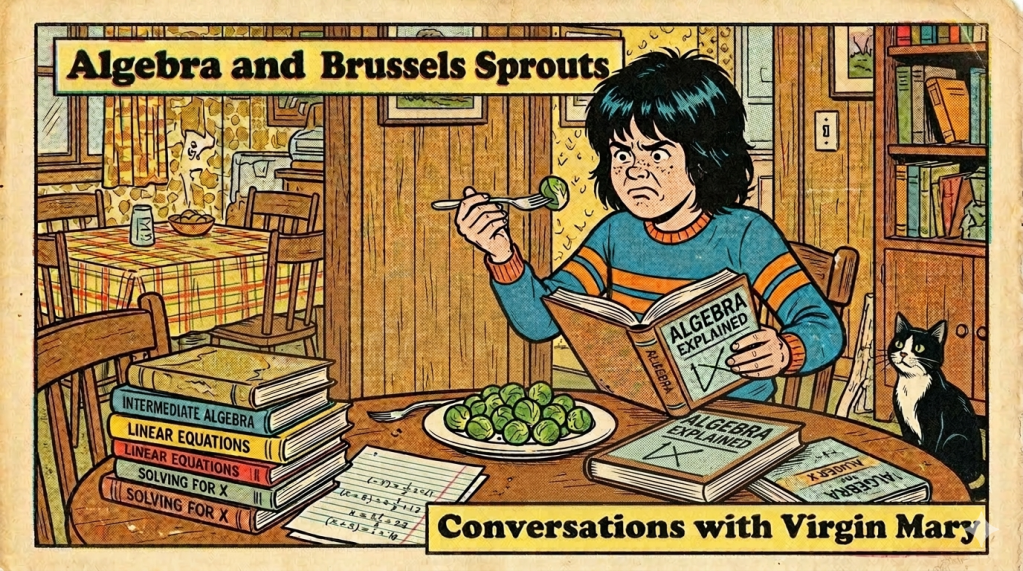
Conversations with Virgin Mary
I showed up at Jorge’s on a Saturday morning. The sun was out and the snow was starting to melt. Virgo was on the porch again, stretched in a warm spot like she had been waiting for the weather to change. Seeing her there felt like a small sign that winter was finally giving up.
She noticed me and started to purr. Then she meowed in that direct way cats have when they expect cooperation.
So I picked her up.
Jorge opened the door before I knocked.
“Come in,” he said.
I stepped inside, still holding Virgo.
“Congratulations,” I said. “I’m here to tell you that your Diesel initiative has been delivered to the David Suzuki Foundation.”
Jorge raised his eyebrows but didn’t interrupt.
“That doesn’t mean anything yet,” I continued. “They just acknowledged that they received it. They’ll review it over the next seven days and then get back to us. But the important part is that your proposal is out there now. Someone will read it.”
I paused.
“And you’ll get feedback, I hope.”
Then I handed him the cat.
“Here’s your cat.”
Jorge was in a good mood. While I took off my shoes he kept singing something under his breath.
“But you know that when the truth is told
That you can get what you want or you can just get old…”
I looked at him.
“What are you singing?”
He stopped and smiled.
“Oh, it’s Billy Joel,” he said. “I was practicing piano when you arrived.”
“You play piano? I didn’t know that.”
“My mother insisted,” he said. “I hated the lessons. The book, the exercises, the whole method. But one day the teacher changed things. Instead of classical pieces he started teaching me pop songs. Chords. Simple progressions. Singing along with the piano.”
He shrugged.
“After that everything changed.”
He picked up Virgo and she immediately started meowing with unusual insistence.
“Alright, alright,” he said to her. “I know. It’s been a long time since our last meeting. Yes, yes, I have work to do.”
He poured some milk into a small bowl for her.
Then he looked at the milk carton in his hand, paused for a second, and took two glasses from the cupboard.
“Do you want a glass of milk?”
I nodded.
He filled both glasses and handed me one.
“So,” he said casually, leaning against the counter. “How’s your mom?”
“She’s incredibly fine,” I said after taking a sip. “Well… she’s eighty-six, so she’s fine for an eighty-six-year-old woman. She still has her problems, but she’s in a good mood. Since my dad passed away something changed in her. It’s like she took a deep breath.”
I thought about it for a moment.
“I like her mood now.”
“And the Parkinson’s?”
“She still has symptoms,” I said. “But her attitude is different. She doesn’t complain about it anymore. And that changes everything. Her desire to do things.”
“Good for her,” Jorge said.
Then he looked at me more carefully.
“Did you learn something from that lesson?”
“Learn something?” I said. “What do you mean? I’m just happy for her. I feel relieved. That’s it.”
He shook his head.
“No,” he said. “What are you learning from this situation?”
I didn’t answer.
“This problem is here for you to think about,” he continued. “It’s not just your mother getting better. It’s also about you and your journey. Sometimes life wraps a problem inside something familiar so you can solve it.”
“You’re always one step ahead of me,” I said. “I never thought of it as a kind of test.”
“It’s not exactly a test,” he said. “And there isn’t always a right or wrong answer.”
He walked to the table and picked up a sheet of paper.
“Here,” he said. “Virgin Mary told me to give you this”
He handed it to me.
“Read it slowly,” he said. “And tell me what you think.”
Thursday, January 29
“Please open your algebra book.”
The teacher pauses and waits for the familiar rustling of paper.
“High School Algebra by J. T. Crawford. Page 213. Problem 18.”
The class knows what is coming next. Algebra problems always arrive with the same solemn ceremony, like a vegetable nobody asked for.
A passenger train leaves a station traveling at 30 miles per hour.
Two hours later an express train leaves the same station traveling at 45 miles per hour.
After how many hours will the express train overtake the passenger train?
At this point something strange happens in the classroom. The problem itself is not particularly frightening. Two trains. Two speeds. A little arithmetic dressed up as algebra.
But the students react as if the teacher had placed a bowl of Brussels sprouts on every desk.
The reaction has nothing to do with algebra. And, if we’re honest, it has very little to do with Brussels sprouts either.
It’s cultural.
Somewhere along the way, children learn two important rules of social survival: you are supposed to dislike algebra, and you are supposed to dislike Brussels sprouts. Parents pass it along casually, the way people pass along family recipes. The message becomes clear very early: if you enjoy algebra—or worse, if you say so out loud—you risk becoming the weird kid in the class.
And nobody wants to be the weird kid.
Teachers understood this long ago. That’s why algebra problems are filled with trains, baseballs, snowballs, and all sorts of everyday objects. The idea was simple: if mathematics felt too abstract, wrap it in something familiar.
Two trains leave a station.
A baseball flies through the air.
Someone throws a snowball.
Suddenly the numbers look less intimidating.
Cooks have developed a similar strategy for Brussels sprouts: wrap it in something familiar. If you search for them online you will find hundreds of recipes—roasted, caramelized, sautéed with garlic, glazed with maple syrup. Humanity has invested an extraordinary amount of creativity into making Brussels sprouts acceptable.
But algebra, when you look at it calmly, is already simple.
That is its secret advantage.
Every algebra problem has one correct solution. One. That’s it. The answer exists somewhere, and—if you are using a textbook—the answer is usually printed in the back pages. If you are uncertain, you simply turn to the end and check.
Imagine how comforting that is.
Life rarely works that way.
Suppose you open a map instead of an algebra book. You are at point A and you want to reach point B. What is the correct route?
There isn’t one.
You could take the highway. You could take side roads. You could wander through small towns and arrive two hours later but happier. Even your daily commute can change depending on the weather, traffic, or your mood that morning.
And the map offers no answer key at the back.
So what do you do?
Perhaps the solution is to treat the map the way teachers treated algebra. Fill it with stories. Populate the journey with trains, baseballs, snowballs—whatever makes the problem feel human, wrapping it with something familiar.
Because sometimes the fear we feel about difficult paths has very little to do with the path itself. Often, it’s the quiet anxiety of standing out, of making the wrong move, of looking like the strange kid who actually enjoys algebra.
The next time you feel uncertain about which road to take, remember the trains from page 213.
The problem looked intimidating at first. But once you started working on it, the answer slowly revealed itself.
Life might not have an answer key printed in the back pages.
Still, the method works.
Fill the journey with trains.
With baseballs.
With anything that makes the problem feel less lonely, wrap it with something familiar, the smell of coffee from your childhood, the news on the radio from your grandpa, the stop at the Ice Cream shop. Dare to be the weird kid in the block.
And suddenly the road becomes easier to follow.
Your task this week will be to cook something that you hate in your childhood, it doesn’t have to be Brussels sprouts, just remember your childhood and think about something you hate, and then wrap it with something familiar and try it again.
This time the messenger will come from the mail, you will receive good news this week.
When I finished reading, Jorge looked at me with curiosity.
“So,” he said. “Tell me about your art. How are things going?”
“Terribly,” I said. “This year has been awful. Every prize I applied to rejected me. At the Jackson’s Prize I didn’t even make the long list. Technically I was eliminated with all the amateurs.”
I took a sip of milk.
“The Sidney Nolan Trust Art Prize. The Derwent Art Prize. Rejection after rejection. ‘We regret to inform you…’ Even the Ontario Society of Artists rejected me.”
Jorge smiled.
“Good.”
“Good?” I said. “What are you talking about?”
“What you’re telling me is great.”
“It’s rejection after rejection. What do you want me to do, reread the letter and wrap it with bacon?”
He laughed.
“Don’t you see the parallel with your mother?”
I frowned.
“Six months ago you were lost,” he said. “You didn’t know how to help her. Every day something worse happened. She was in a bad mood. She didn’t want to try anything new.”
He paused.
“And now look at her.”
I nodded.
“You’re on the same road,” he continued. “That’s how you wrap a problem with something familiar—not bacon, but your own experience.”
Virgo walked around my feet, meowing again.
Jorge pointed at her.
“See? Even Virgo agrees with me.”
“I don’t know,” I said. “This week everything feels far away. I failed at every shot I tried.”
“Yes,” he said. “But you tried. You showed up. That’s the only way to reach your goal.”
He leaned forward.
“What would have happened if you hadn’t submitted anything?”
“That would guarantee no rejection letters.”
“Exactly,” he said. “Your rejection letters are trophies. Proof that you are playing the game.”
He took another sip of milk.
“And statistics is on your side.”
“Statistics? I hate statistics.”
“Remember, that’s cultural not your fault. What was your acceptance rate last year?”
“About twenty-five percent. One out of four.”
“And now you’re at zero percent.”
He smiled.
“That means a hit is coming. That’s not magic. That’s math.”
I finished the milk and looked at him, unconvinced.
Jorge just smiled, walked to the piano, opened the lid, and struck a jazzy chord.
Then he began to sing softly:
“When will you realize…” he continue playing
Vienna waits for you…” and he finished the song with the classic waltz of the song.


 Carlos Fentanes
Leave a comment