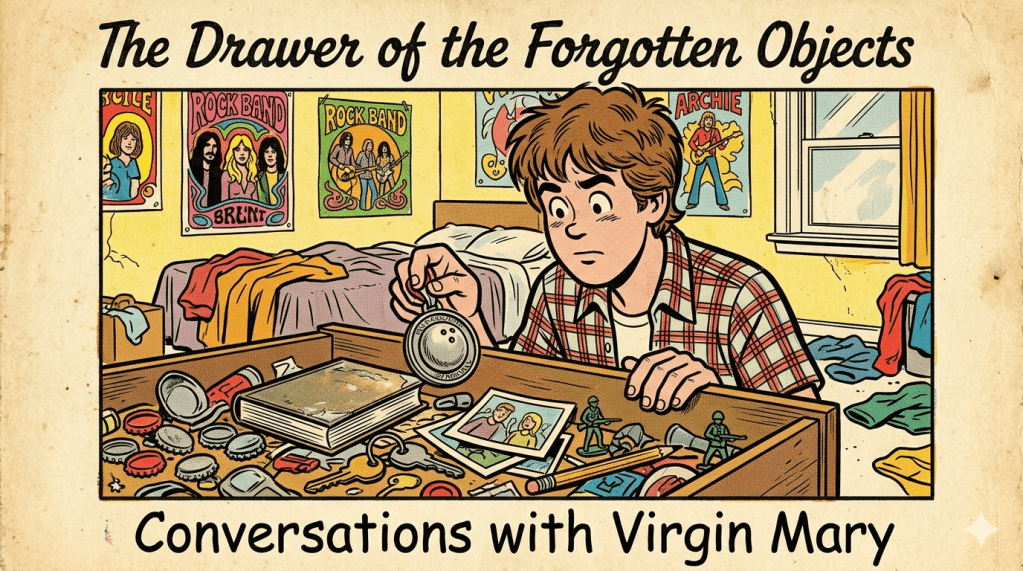
Conversations with Virgin Mary
Fourteen days after sending the bill proposal, the reply arrived.
Not from the Member of Parliament himself, but from the system surrounding him.
Good day,
Thank you for reaching out to MP Jacob Mantle with your concerns.
This message confirms that our office has received your correspondence. Due to the high volume of inquiries we are currently managing, we will contact you as soon as we are able with a response from MP Mantle.
Thank you kindly for your patience.
Sincerely,
 | Office of Jacob Mantle Member of Parliament, York—Durham E: Jacob.Mantle@parl.gc.ca Ottawa Phone: (613) 995—3432 Constituency Phone: (905) 722—7500 |
“Fourteen days—for an automatic response,” I told Jorge. “Which raises a simple question: if an idea takes two weeks to trigger a template reply, what are the chances it survives first reading?”
“It doesn’t matter,” Jorge said, pouring tea into two cups with deliberate calm. “The ball is on their side now.”
He reached into the pantry and pulled out a small cardboard box. “Here’s the sugar—sugar cubes for the tea. Can you check that drawer and find the tongs?”
He seemed more focused on the ritual of making tea than on my frustration.
I opened the drawer and began searching. “Wow… a medal,” I said. “A coconut medal? How did you earn this?”
“Let me see.” He leaned closer to inspect it. “That’s not a coconut—it’s a bowling ball. I was on the company bowling team at the sneaker factory, back when I was curing soles. Remember? We were called The Lost Souls… or maybe The Lost Soles.” He paused. “There were soles all over my station. Maybe that’s why.” He reached past me. “Here are the tongs.”
He placed them on a tray with the sugar cubes and handed me a teacup and a small spoon.
“Don’t worry about your MP,” he continued. “That’s how it works. They’re slow when it comes to difficult questions. But that wasn’t the point of my bill. Now nobody can say it’s hard to write one. It’s not rocket science. What is the job of a legislator if not making laws?”
“Well… an MP is not just a legislator,” I said. “The role is diffuse by design—part local representative, part federal intermediary, part political antenna. They’re expected to solve problems, interpret signals, and operate within a system that rewards caution more than initiative.”
I dropped two sugar cubes into my tea and stirred slowly.
“You achieved your goal,” I continued. “You presented a bill that is necessary—arguably even obvious in its benefit. But what happens next? Do you get a medal? A diploma? Does anything actually change?”
Jorge paused. He took a sip of tea, then put on his glasses.
“You’re wrong,” he said. “Getting involved changes everything. You may think it’s useless, but now there’s a document on his desk. A real one. Something he has to look at. And now he has a choice.”
“Yes,” I said, glancing back at the message on my phone. “A choice: file it away in a drawer with the rest of the forgotten proposals.”
I paused, then added, almost automatically, “Of course he will. That’s what they always do.”
Jorge didn’t seem convinced.
“I’m not so sure,” he said. “Maybe now it’s not the right moment for that bill, but sooner or later the public will start to talk about this specific problem and if Jacob is still an MP he will reach that drawer and take out my bill. But that’s only one path. You told me you sent it to CUTA as well. There’s still an exit for this bill.”
“Now that I’m talking about lost soles, I have a letter from Virgin Mary about it, let me look into my own drawer of forgotten objects.”
Thursday, June 10th
Have you ever wondered where lost socks go?
You place a pair in the washing machine. You are certain of it. But when the cycle ends and you begin folding, one is missing. A single sock, gone without explanation.
It didn’t vanish.
You were not paying attention.
Your mind was elsewhere—occupied with what you consider important. And so a simple task became incomplete. You dismissed the small detail, assuming it did not matter.
But being present is not a small thing. It is the task.
And sometimes, being present means following the path of something as insignificant as a missing sock.
Now, look at the drawer in your night table—the one you rarely open.
No, there are no lost socks there. But there are lost moments.
Objects remain: a medal, a photograph, a fragment of your past. You recognize them, but not completely. The details have faded. The context is unclear. You hesitate.
Do you remember when you earned that medal?
Do you know who stands beside you in that photograph?
These are not trivial questions.
You preserved these objects for a reason. At some point, they mattered enough to keep. They are part of your story—evidence of who you were at a specific moment in time.
But you moved on.
You focused on what felt important, and in doing so, you allowed other parts of your life to recede. Not disappear—but lose clarity. Do you remember where you left the missing sock?
It is time to open that drawer again.
Take those objects out. Look at them again. Not as you did then, but as you are now. You will see something different. The story will not be the same, because you are not the same.
What was once immediate is now distant. What was once obvious now requires attention.
This is the point.
To observe. To reconnect. To recognize that your life is built not only from what you pursue, but also from what you overlook.
Do not let everything become a “missing sock.”
When a sock goes missing, it is not the sock that matters. It is the moment you were absent.
It’s me there talking to you, pulling your ear. Consider it a messenger.
A reminder that attention is not optional. It defines your experience.
I will give you a simple task.
Wear mismatched socks—something noticeable. Let it interrupt your routine. Let it remind you, throughout the day, to return to the present moment.
You may receive a messenger—something connected to what you find in that drawer. It could take the form of an object, a message, or a recognition.
When it appears, you will understand it.
I finished reading the letter and almost immediately said, “Are you telling me I lose my socks because I’m not paying attention?”
“It’s not me,” Jorge replied. “It’s Virgin Mary. I’m not implying anything. How would I even know you lose your socks? Her teachings are usually about mindfulness, self-discipline, patience.”
“Now that you mention self-discipline,” I said, shifting the conversation, “at the opening of the show at Latcham, I met my engraving teacher. She had just returned from Japan—from a workshop on mokuhanga, the traditional technique of woodblock printing. You know—the method behind prints like The Great Wave off Kanagawa by Hokusai.”
“She was telling me about Japanese culture—about how Zen practice is grounded in mindfulness and discipline. But there was something else. She showed me one of her prints in the exhibition—a bonsai. And she said, ‘If you get close enough, you can still see the grain of the woodblock.’”
I looked at him.
“The grain of the woodblock,” I repeated. “That detail stays in the image. It doesn’t disappear. It becomes part of the final piece. The wood grain from the previous letter was there in front of me during the reception”
For a moment, the connection felt obvious.
“Virgin Mary was there,” I said. “Mindfulness. Discipline. Back and forth.”
I shook my head slightly.
Jorge watched me for a second. Then a small grin appeared on his face.
“Those messengers always find their path.” he said.


 Carlos Fentanes
Leave a comment