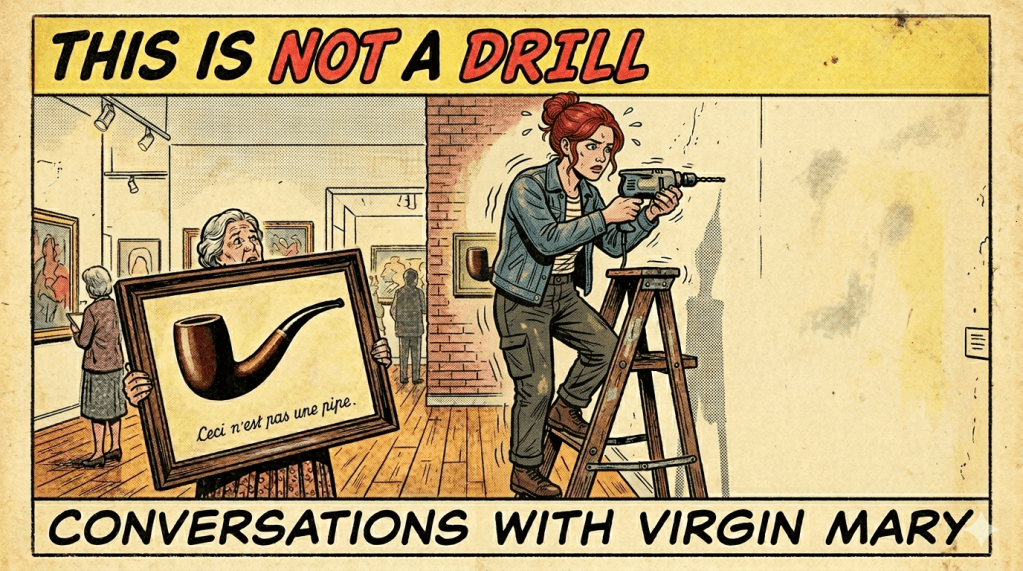
Conversations with Virgin Mary
“You should wait until I arrive. This task is hard for one person,” I tell Jorge as I watch him halfway up a ladder, a drill in his right hand, balancing.
“I waited for you,” he says without turning. “You said five. It’s almost six-thirty.”
“I sent you a message. Didn’t you get it?”
“A message?” He looks at me now, blank, almost offended. “If you say five, I organize everything around five. If you come late, it’s like lying.”
He sets the drill down, and walks into the kitchen. A few minutes later, water is boiling.
There’s something ritualistic in what follows. He pulls out a vacuum-sealed bag—the kind you associate with good coffee. The packaging is minimal, elegant, covered in kanji. Without reading it, you already think you understand what’s inside.
He measures the contents into a metal filter. Dark, granular. Again, familiar. Then something unusual: instead of brewing it like coffee, he dips the filter briefly into hot water, lifts it, repeats the motion. A kind of controlled hesitation. Not quite brewing, not quite steeping.
The liquid he pours into two small glasses is pale. Coffee-colored, but only just.
He hands one to me.
“Taste this.”
I don’t hesitate. Why would I? Everything about the setup says coffee.
But the moment it touches my mouth, something breaks.
It’s soft. Light. Almost polite. There’s no bitterness, no weight. It feels closer to tea than coffee—but my brain hasn’t caught up yet. For a second, I don’t know what to do. Swallow? Reject? Re-evaluate? I stay there, suspended between expectation and reality.
I swallow.
“What is this? That’s not coffee.”
“Of course it’s not coffee,” he says calmly. “It’s Hojicha. Japanese roasted tea. Didn’t you see the package?”
I didn’t. Not really. I grab the bag and start to examine: ほうじ茶, Hōjicha, Hōji Tea, is what it said, What is Hōji?”
“Roasted, I already said”
“My senses lied to me,” I say. “I saw the bag and decided it was coffee. Japanese coffee, maybe. I didn’t read it. I just… assumed. And then you used something that looks exactly like ground coffee. How was I supposed to know?”
Jorge doesn’t answer immediately. He just sips his drink, unbothered.
“I didn’t deceive you,” he says finally. “The package did.”
He looks at me as if he’s about to explain something, then suddenly turns toward the door and opens it. I didn’t hear a knock.
Virgo walks in, meowing, moving with the confidence of someone expected.
“Do you think he needs a lesson?” Jorge asks her.
Virgo responds, as cats do, with complete indifference.
Jorge disappears again and comes back holding a folder.
“The Virgin Mary letters,” I say.
“You still don’t understand,” he replies. “It’s not the Virgin Mary. It’s Virgin Mary.”
“What’s the difference?”
He pauses, just long enough.
“The difference is the essence,” he says. “Same as the difference between coffee and Hojicha.”
Then he hands me the letter.
Wednesday, March 6th
We will play a quiet game now.
Choose a number between zero and nine.
“Five.”
A gentle choice. Listen closely.
Five does not strive to become four, nor does it pretend to be seven. It does not negotiate its nature. From the beginning, it has remained what it is, and it will remain so until the end of time. It neither exaggerates itself nor diminishes itself. It does not wear disguises. In its stillness, it is whole.
This is why it can be trusted. Not because it is greater, but because it does not drift. It does not compete for identity. It simply is. A five is always a five.
And so it is with all numbers. One is not in conflict with eight, nor eight with one. Each carries its own truth. Each exists without needing to imitate another. Difference does not require hierarchy; it requires recognition.
Do you understand?
Then consider this: why do you step away from what you are? Why do you bend your form into something borrowed? Why do you speak as though truth were insufficient?
To lie is not merely to deceive others—it is to fracture your own presence. It is to become divided within yourself. But truth gathers you. Truth makes you whole.
Be as the number five, that does not change to be accepted. Be steady in your own measure. Not lesser, not greater—simply aligned with what is real.
You are not diminished by being what you are. Comparison is a distortion; it turns clarity into confusion. Each life is given its own position, its own meaning, its own place among others. No number is complete alone, and none is complete by imitation.
Five cannot fulfill its purpose by becoming seven. It fulfills it by remaining five, and by standing in relation with the others.
So too with you.
Speak truth, and your words will hold weight.
Live truth, and your presence will be dependable.
Do not divide yourself through falsehood.
Remain what you are, without embellishment or concealment.
And in this, you will be known—not for what you pretend to be, but for what you truly are.
I have a task for you—simple in appearance, yet revealing in its nature.
Take the last balance of your bank account. Examine each movement with care. Verify every entry, every subtraction and addition. Seek clarity in what has been recorded, and order in what has been accounted for.
But I will ask you to use one restriction: you may not use the number five.
Attempt this work without it. Proceed as though it were absent. You will find, in time, that something essential resists completion. Not because you lack ability, but because something foundational has been removed from the structure itself. What seems minor is, in truth, woven into the integrity of the whole.
My messenger this week will not arrive as words, or as a symbol, nor as something distant or abstract. It will take the form of the number five. You will encounter it quietly, in moments that require your attention.
Number five this week is not just a number, it’s me.
So attend carefully.
When the messenger appears, do not rush past it. Pause. Observe. Understand.
“This letter reminds me of something I’m working on,” I say. “It’s a wooden box, painted to look like an Amazon package. Like those Brillo Boxes from Andy Warhol. A trompe l’oeil.”
“Trump what?” Jorge says immediately. “Don’t mix politicians with art. It’s like water and oil.”
“No, not Trump. Trompe. French. It means to deceive. Trompe l’oeil—to deceive the eye.”
He nods slowly, not convinced.
“So you’re cheating. Pretending to be something you’re not.”
“That’s not quite it,” I say. “It’s not cheating—it’s imitation taken to its limit. Precision. I have a friend in Guadalajara who does hyperrealism. He once told me the best compliment he ever got was someone saying, ‘That’s obviously not a painting. It’s a photograph.’”
Jorge looks down at his cup.
“This is tea,” he says. “There’s no confusion about that now. You thought it was coffee because of the signs around it. The bag. The color. The way I made it. But in the end, it’s still tea. That’s its nature.”
He pauses.
“So why make a wooden box that looks like cardboard? Or a painting that looks like a photo? What are you trying to achieve? Deception?”
“It’s a fair question, and not the first time I’ve heard it.”
“My friend sells his paintings,” I say. “Very well, actually. No one is being tricked. People know exactly what they’re buying. That’s the point—they’re buying the precision, the resemblance. The tension between what it is and what it looks like.”
I take another sip. Now it tastes like tea. Completely. The illusion is gone.
“It’s the same with the Brillo Boxes,” I continue. “They weren’t trying to fool anyone. They were pointing at something. Finding meaning in ordinary objects. A cardboard box, a detergent package—things you normally ignore.”
Jorge scratches Virgo absentmindedly.
“I’ve never really understood art,” he says. “What I know, I learned from you. But it sounds like modern art is just… deception. You cheat, and that’s how you succeed. Like saying you’ll arrive at five and showing up ninety minutes later so people notice.”
“That hurts,” I say. “It’s very direct.”
He stands up, picks up the drill, and walks back to the ladder.
“Be grateful I don’t have a hammer,” he says. “That would hurt more.”
“I know,” I say. “It’s a drill.”
He looks back at me.
“Be smarter,” he says. “This is not a drill.”


 Carlos Fentanes
Leave a comment