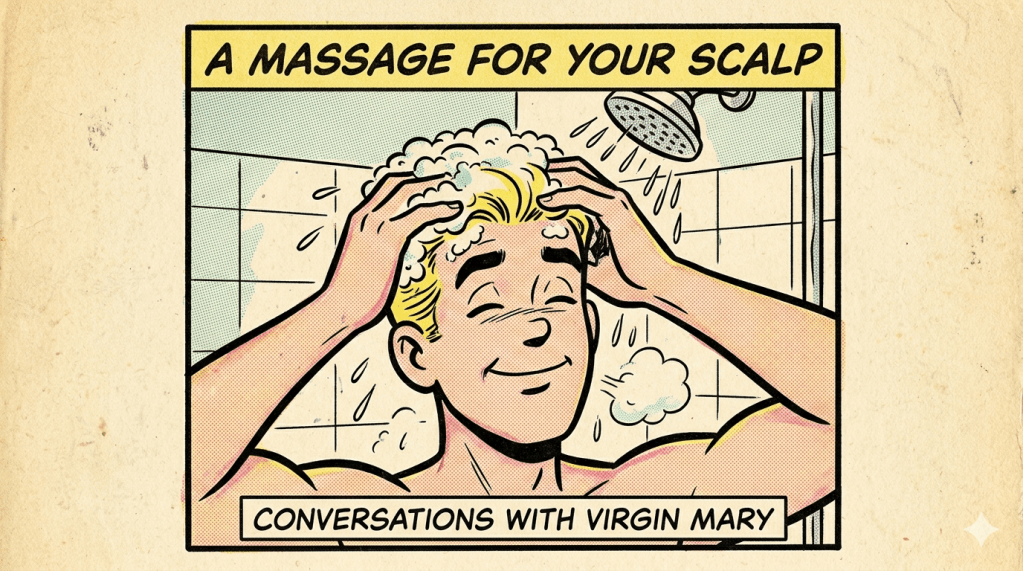
Conversations with Virgin Mary
Everything I plan refuses to end as planned.
I have been sending applications to every open call where I believe my work belongs, and the results have been the same: rejection. I have grown so accustomed to rejection letters that they no longer surprise me. I don’t ask why anymore. I simply file them away, one by one, in the drawer of unsuccessful calls.
The most recent one was the Jackson’s Prize in the UK. I was certain—completely certain—that I would pass the first round. It felt inevitable, almost procedural. But I didn’t. My work didn’t make it past the initial filter.
And that thought stayed with me:
if it didn’t pass, then it can be placed alongside everything else that didn’t—alongside the amateur works, the flat flowers, the animals without meaning.
What am I missing?
I believed I was moving in the right direction. But these repeated failures have forced me to reconsider my path. Something is absent. I just don’t know what it is.
Carrying this disappointment, I went to visit Jorge, hoping to find some meaning in the middle of this confusion.
He opened the door as he always does, with a smile.
“Come in. I was waiting for you. My wife was asking about you—where you’ve been.”
I stepped inside and took off my shoes, wondering, not for the first time, why I had never actually seen his wife.
Virgo, the cat, was sitting at the dining table beside a scattered arrangement of papers. For a moment, I thought Jorge must be channeling Virgin Mary again.
“What are you working on?” I asked.
The cat meowed and stared at me. Jorge, meanwhile, was in the kitchen, reaching for two glasses and a pair of bottles filled with a cloudy brown liquid. He loosened the caps.
“Oh, just my taxes,” he said. “You know how it is this time of year. I’m putting everything in order—receipts, expenses, invoices. Cleaning the mess I’ve accumulated since last year. I organize it so my accountant can make sense of it all. He’s my cleaning agent. He tells me what to keep and what to discard. It’s easier that way. I can’t do everything myself.”
“A cleaning agent,” I repeated. “That’s exactly what I need—but not for my taxes. I already have an accountant in Saskatoon. I need one for my submissions. My applications are a mess—sent everywhere, with little success and plenty of expense. I need someone to organize it. Not an accountant… an agent. Like writers have. Like actors have. Why don’t artists have agents?”
Jorge looked at me, almost amused.
“They do,” he said. “They’re called gallerists. They do the work you’re complaining about—and they enjoy it.”
“Yes, I know,” I said. “But finding the right one is the problem. Every gallery moves in a different direction—different markets, different tastes. When I was younger, I worked with Oscar in Mexico City. I was comfortable there, but his market leaned toward the decorative. It wasn’t about pushing boundaries. I felt restless. I had to produce things I didn’t believe in. Still lifes, flowers… but I didn’t know how to speak through them. I needed a different kind of gallery—and I still haven’t found it.”
He placed one of the glasses in front of me. The liquid inside was cloudy, amber.
“What’s this?” I asked.
“Kombucha,” he said. “Fermented. Good for your gut. That’s what you need right now.”
“And,” he added, “I prepared a letter from Virgin Mary for you. She told me you wouldn’t be in the right state of mind, and that you would need it. Read it. It helped me when I needed it.”
Friday, April 23rd
Let us speak now of shampoo.
Tell me, what kind do you use?
Is it perfumed, or does it carry no scent at all?
Is it made to fight dandruff, or to soften what is already gentle?
Does it come in a small bottle, humble and transient,
or in a larger vessel that rests permanently in your shower?
Some prefer the ease of a dispenser,
others the simple act of unscrewing a cap.
Some are filled with color, others remain clear and without fragrance.
There are even those that promise two things at once—
to cleanse and to condition.
The variety appears endless.
Among the countless options set before you,
no two are exactly the same.
And yet, all share a single ritual:
they must be placed upon the scalp,
worked with the hands,
and then released with water.
Understand this:
water is the primary carrier in the act of cleansing.
It receives what has been loosened and carries it away.
But water alone cannot complete the task,
for it does not bind with oil.
This is why shampoo exists.
Within it are small agents, unseen yet precise,
each one shaped with two natures:
one that is drawn to water,
and one that is drawn to oil.
They gather what does not belong—
the residues, the weight, the excess—
and hold it within themselves.
As you massage your scalp,
they assemble into tiny spheres,
capturing what must be removed.
And when you rinse,
water carries these burdens away.
So it is not water alone that cleans,
nor shampoo alone that transforms,
but the meeting of both—
a cooperation between elements that would otherwise remain apart.
In this, there is a lesson for you.
You may believe that your discipline is enough,
that your focus alone will cleanse your path.
But this is like washing your hair with water only—
it helps, but it does not complete the work.
You need the shampoo, the agent that carries the dirt away,
it won’t replace your effort;
it makes it effective.
It gathers what you cannot see,
what you cannot remove on your own.
I have guided you quietly,
clearing what you could not name,
lifting what you could not carry.
There are burdens that require more than your strength.
There are moments that require the presence of another.
Don’t be afraid of using shampoo because it ruins your hair, in fact it’s quite the opposite.
I have a task for you.
Wash your hair with water only—no shampoo.
Stop, and feel what remains.
Notice the difference, even if you cannot name it.
A messenger will reach you in the form of hair.
It will appear when you are not looking for it.
Do not search. Just wait.
“You cannot do all the work by yourself,” Jorge said. “It’s like washing your hair with water alone. Ha… Virgin Mary is a little sarcastic today. I didn’t understand why she asked me to bring out this letter, but now I do. She knows.”
“I work alone,” I said. “When I’m in my studio, it’s just me and my thoughts. Like most artists, I have to do everything myself. I don’t understand that aphorism—using shampoo, not just water. What does she mean?”
“You are always blind to her messages,” Jorge replied, sipping his kombucha. “It’s clear to me.”
“Yes, as clear as this sewer water,” I said.
“It’s kombucha. And it’s good for your gut. Drink it.”
I obeyed. I took a sip and couldn’t hide the sour expression on my face.
“Good. It’s not that bad—you just need to get used to it,” he said. “What I think the message means is that you need a translator. How can your audience understand your work if you don’t give them a thread to follow? Without that, they can’t enter it. They won’t grasp it.”
“How can I give them a clue if I’m the one who is lost?” I said. “Sometimes I don’t even know what I’m aiming for, what these drawings mean. My ideas are as cloudy as this… this… kom-boo-sha, or however you say it.”
“Kombucha,” Jorge said, more seriously this time.
“It’s curious how my work has changed,” I continued. “It’s become more conceptual. I focus more on my internal state than on the final result. Yes, the work is well rendered—but that’s not the point. What matters is what’s hidden in the composition, in the materials, in the tools.”
“The more abstract my thinking becomes, the harder the work is to digest.”
“That’s when a work becomes interesting,” Jorge said. “When it can be read in different ways, on different levels. It’s like European cinema—like Wim Wenders. You watch his films once, then again, and each time they reveal something new—about the story, the author, and yourself.”
He paused.
“Maybe your work doesn’t belong on Instagram or in online submissions. There, the viewer gives you one or two seconds and moves on. Your work needs time. It needs a space where people can stand, wait, sit, and return to it—a gallery, a museum.”
He leaned back slightly.
“I don’t know much about visual art,” he added, “but I know films, novels, books. That’s how the strongest authors work, isn’t it?”
I took another sip of the kombucha and kept my eyes on the glass.
“Yes,” I said. “That’s how it works in art too. You have to return to a piece several times to understand it. But in open calls, judges barely spend two minutes looking at a JPEG among thousands of submissions. It’s not enough time to judge anything. They’re not evaluating—they’re guessing. Being selected feels less like recognition and more like holding a winning ticket.”
“I see,” Jorge said. “Then that space is not meant for you. If your work requires time, it cannot live there. Now I understand why you’re asking for an agent. It makes sense.”
He finished his kombucha and looked toward Virgo.
“This man needs to forget about results,” he said, “and stop complaining about how cruel the world is to him.”
Virgo meowed in quiet agreement.
“Remember,” Jorge continued, turning back to me, “this is a map. It won’t tell you exactly what to do, but it will show you possible paths. If the road you chose didn’t work, you don’t despair—you look at the map, you smile, and you change direction. I want to see where the next path takes you.”
I looked at him, still holding the glass.
“In an age of Google Maps, where everything is optimized and calculated,” I said, “why is the Virgin Mary giving me a map? What I need is a GPS.”
“Don’t be so dramatic,” Jorge said. “I once got lost in Tokyo with my wife, relying on a map that made less sense the longer we looked at it. No one to ask, no clear direction—we get lost and somehow, it became one of the most exciting moments of my life.”


 Carlos Fentanes
Leave a comment