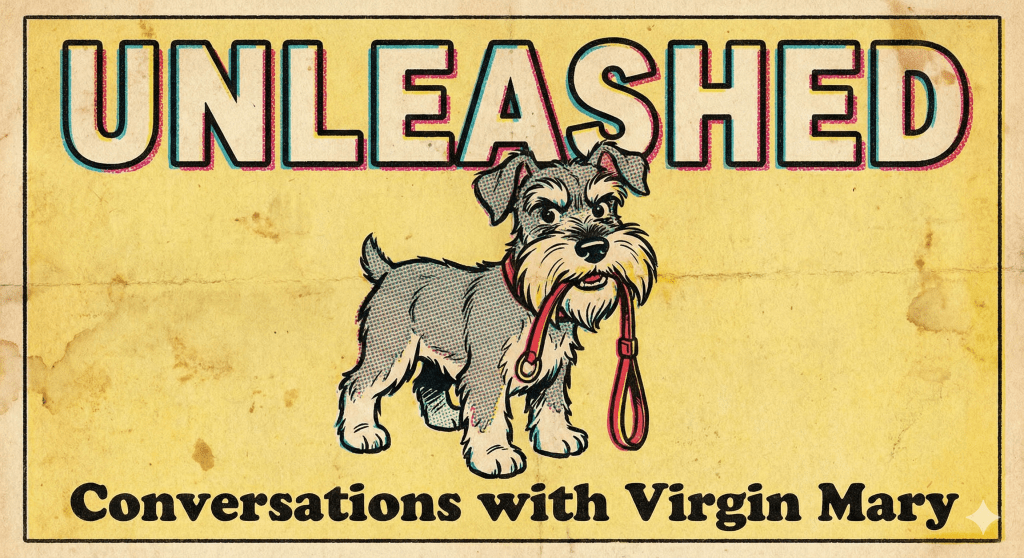
Conversations with Virgin Mary
Wednesday, December 1
Your dog knows you better than you know yourself—or at least better than you admit on the days you still want to think well of yourself.
She reads what you cannot hide—your patience when no one is watching, your kindness when nothing is gained, your cruelty when you think it doesn’t matter. Treat her well and she becomes confident, loyal, steady. Treat her badly and she becomes what you made her: anxious, aggressive, broken.
The same is true of your children. Of anyone you have power over.
This week: unleash your dog in the park. Watch. Does she stay near, or does she run seeking better company? Her choice tells you who you’ve been when you thought no one was keeping score.
The messenger will be a child or an animal showing you what you’ve taught them—about trust, about safety, about whether your presence is a gift or a burden.
Last Sunday we saw The Sound of Music downtown. I kept thinking how the Von Trapp children’s faces told the whole story: stiff marches giving way to barefoot singing once Maria arrived. A house turned into a home by someone who refused to treat love like a military exercise.
The next day I planned to visit Jorge, but Lulu insisted on a walk, so I brought her along. When we finally met, I told him about the play. I couldn’t help comparing the Von Trapp household to my own childhood home under my father’s constant watch. I always felt uneasy around him. He was a good man, but bipolar, and without meaning to, he often hurt the people closest to him. I admitted that for years I avoided visiting my mother because he was there. Only after he died did I start going more often. In fact, this Christmas will be my third visit in a year.
My wife always remembered my dad with love—he called her on every birthday. She never painted him as a demon.
But we—the three brothers—flew away as soon as we were “unleashed.”
Jorge listened without interrupting. After a long silence he said, “I have been a demon too.” He laughed once, dryly. “I know I can be unbearable. People have walked away. My own exit from the shoe company—” He waved a hand, as if brushing away smoke. “Part of it was my mouth. I was passionate about the machines, the process, but the people running them? I decided they were ignorant. Pride. Stupid pride.
Then he asked, “After your father died, did you talk about any of this with anyone? With your brothers? I don’t think your father was the villain of your story. I think you dressed him like one because it served your narrative at some point. But that story doesn’t help anyone—not even you. You should make peace with your father. Speak to him, even in prayer. You need to close that chapter, and it needs a gentle ending. Don’t leave it loose.”
I told him my wife had been saying something similar—not to “talk” to my father, but she always described him with a kind of gentleness that is slowly changing the way I see him.
“When you visit your mother this Christmas, you have work to do, you need to talk about your father with your mom and I bet you that you’re going to hear a new story, something you had avoided several times, the story of a good man who loved his children.”
Lulu was waiting by the door. When I stood to leave, she didn’t run to me immediately—she looked at Jorge first, as if asking permission. He smiled and nodded, and only then did she come.
“See?” Jorge said quietly. “She’s learned to check. To wait for approval. What did you teach her about trust?”
I didn’t have an answer.


 Carlos Fentanes
Leave a comment