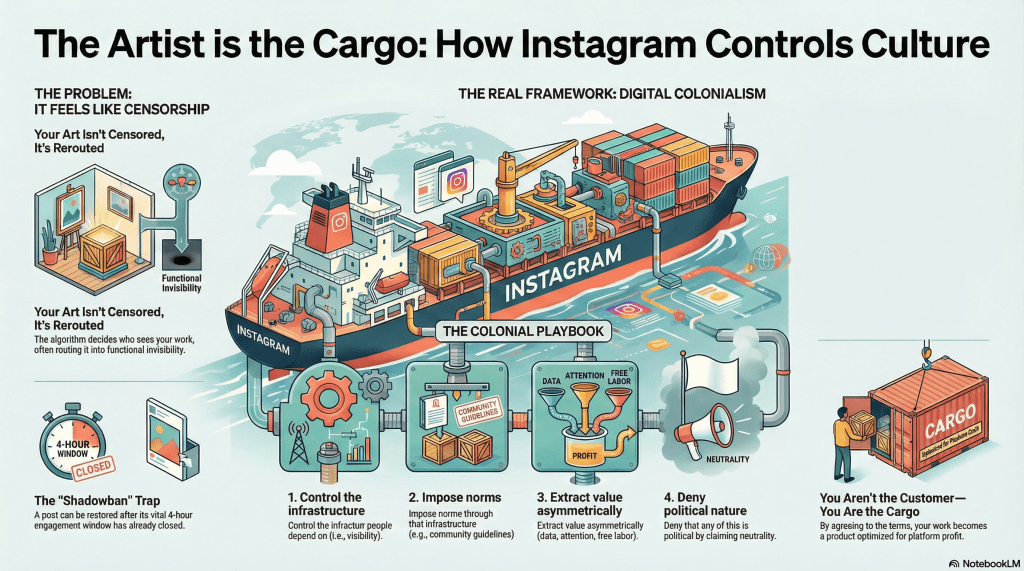
Logistics as power on Instagram
Censorship?
At first, it doesn’t feel political.
You open Instagram. You post an image. Sometimes it reaches people; sometimes it doesn’t. Sometimes nothing happens at all. No message, no explanation—just silence. You assume it’s you. Maybe the image wasn’t strong enough. Maybe the timing was wrong. Maybe the algorithm didn’t like it.
This is how power works best: when it convinces you that its effects are your fault.
For years, artists have argued about censorship on social media as if it were a moral dispute—about nudity, obscenity, violence, taste. Movements like Free the Nipple or Don’t Delete Art frame the problem as a battle over content. But that framing misses the deeper story. The real issue isn’t what Instagram allows or forbids. It’s something more structural, and much older.
I’ve been shadowbanned. Posts restricted or erased for “nudity,” even when there is none—just bare skin flagged by an algorithm, my last attempt to avoid censorship failed, it was the “Rokeby Bathroom through the looking glass”, the center figure was a nude girl but conveniently covered so you cannot see her private parts, the AI embedded on Instagram immediately flagged as nudity.
Instagram allowed an appeal. Next day, the post was reinstated—but the algorithm had already decided. There’s a four-hour engagement window where the algorithm considers if your content is viral enough to be distributed, that window was already expired. The work exists on the platform, technically visible, but functionally erased. Not censored. Routed into invisibility. My cargo didn’t arrive to its final destination.
For years I thought that fighting against censorship was the flag we artists hold with proud. Now, I have my doubts about this, I have my doubts about fighting against an imaginary giant controlled by an automatic algorithm. The algorithm doesn’t censor. It routes.
There’s no way to establish a dialogue, trying to convince it, nothing is going to change because Instagram doesn’t host art, It controls the route content travels on. Instagram is feeding cravings, it doesn’t care about content or about art, it reroute content according to reaction.
Instagram controls the route and whoever controls the route controls the culture.
The Port Is Not the Power
If Instagram merely controlled access—if it were just a port—you could work around it. Post somewhere else. Build your own site. Send newsletters. And artists do all of that.
But the port is not the real power.
The power lies in the route.
Instagram doesn’t just decide whether your work is allowed. It decides who sees it, when, how often, and in what context. It routes attention according to its own interests: engagement, retention, advertising safety, legal exposure. Your intent is secondary. Your audience is not really yours.
This is not hosting. It’s logistics.
Instagram is not a gallery. It is a shipping company for culture.
The East India Company
Historically, empires understood this well. The East India Company did not conquer India by marching armies inland. It controlled shipping routes. Once you owned the route, sovereignty followed naturally.
Instagram works the same way. It doesn’t tell you what to make. It decides whether what you make arrives at all.
And in this arrangement, the artist is not the customer.
The artist is the cargo.
By clicking agree, you consent to be distributed wherever the platform deems most profitable. Your work is no longer your merchandise; it is converted into entertainment goods, optimized for circulation rather than meaning.
Some countries have laws intended to protect against this kind of abusive mediation. Social media platforms do not. Each platform writes its own regulations, and acceptance is mandatory. There is no negotiation—only access or exclusion.
The problem with Instagram is not about censorship but control. Art for Instagram is just another good transported from port A to port B, they don’t care about content, the community guidelines are just to legally protect them in the USA and appease advertisers, they care about traffic, and if the cat videos generate more traffic with less legal issues they will prioritize that at expenses of culture or “Art” or even your personal priorities, Art gives Instagram cultural legitimacy—a facelift—but generates minimal economic value compared to entertainment.
Consent, Technically Speaking
And if you object to being treated as cargo? Instagram has an answer ready.
Instagram’s defense is elegant and devastating in its simplicity: You agreed to the Terms.
That sentence has become the modern equivalent of a divine right. It shuts down argument. You clicked “accept.” Case closed.
Except it isn’t.
Consent, in any meaningful political or ethical sense, requires more than a button. It requires alternatives, symmetry, and the ability to refuse without punishment. Instagram offers none of these. You don’t negotiate the terms. You don’t vote on them. They change without notice. And opting out doesn’t mean choosing another equal space—it means disappearing.
This kind of “consent” has a long history. Colonial powers were masters of it. Treaties signed under duress. Agreements written in languages no one read. Charters that transformed dispossession into paperwork.
The existence of a document was later used as proof that no imposition had occurred.
Instagram’s Terms of Service play a similar role. They don’t prevent domination; they legitimize it.
The Infrastructure of Empire
Colonialism is often misunderstood as a story about flags and armies. In reality, it was about infrastructure. About imposing systems that made certain outcomes inevitable and others impossible.
The classic colonial pattern looks like this:
- Control the infrastructure people depend on
- Impose norms through that infrastructure
- Extract value asymmetrically
- Deny that any of this is political
Instagram fits this pattern uncomfortably well.
It controls the infrastructure of visibility. It enforces a narrow moral framework while presenting it as universal. It extracts value—data, labor, attention, legitimacy—while distributing rewards unevenly. And it insists, above all, that it is neutral.
Colonial powers always insisted on neutrality.
The Solitude of a strike
The instinctive response is a strike. A blackout. “Artists of the World, Unite!”. Stop posting for a day.
It wouldn’t matter.
Instagram no longer depends on art. It runs on entertainment. Cat videos, influencers, frictionless dopamine. Art provides cultural legitimacy, not traffic. Removing it quietly would change nothing.
Removing it loudly—turning the platform itself into the subject of critique—might.
Artists don’t have labor power here. They have symbolic power. Their role isn’t to shut down the factory—it’s to signal the emergency exit.
The Emancipation Question
If this really is a form of digital colonialism, then history suggests an evident exit: Emancipation, but emancipation doesn’t arrive as a single event.
There is no digital 1776 coming. No storming of the algorithm.
Colonial systems that operate through infrastructure don’t collapse. They are constrained. Bound. De-centered.
The Magna Carta didn’t abolish monarchy. It limited it. It introduced the radical idea that power must justify itself.
That is the kind of emancipation the digital world hasn’t had yet.
This is not an Instagram problem.
It’s the political economy of visibility before its Magna Carta.

 Carlos Fentanes
Leave a comment