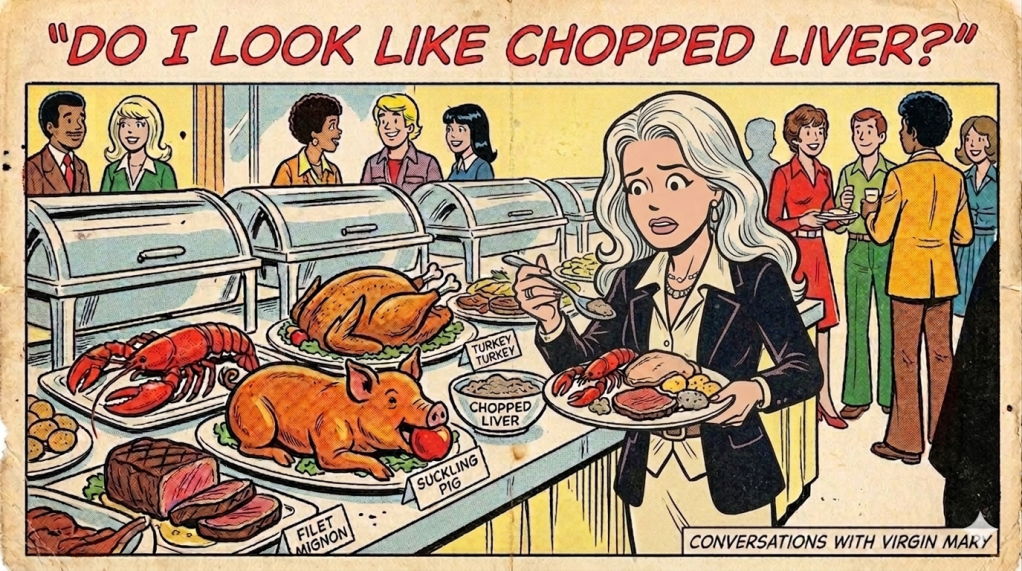
Conversations with Virgin Mary
Spring is around the corner, and my garden is hungry for fertilizer. On Saturday, I took out all the gardening tools and a bag of fertilizer. I was about to start when I heard the doorbell.
It was Jorge, holding a carton of lemonade and a folder in the other hand.
“Did you forget about me? I haven’t heard from you in a while. Where have you been?”
I invited him in.
“I just came back from Milwaukee. We’re updating their fareboxes—we developed a new cashbox that doesn’t need a key. It’s secure, keyless. We had a meeting last week where we showed them the new system.”
“Where are the glasses? This lemonade has been calling me since I left my house.”
“How’s your mother? How is the Parkinson’s progressing?”
“It’s hard to say. I call her once a week, and I send her messages every day. She says she’s OK. Old—but OK.”
He started pouring the lemonade.
I continued, “But she’s getting better everyday, I started to notice this in the months after my dad passed away. My mom was liberated as if he had been pulling her into sickness. She used to complain about diabetes, Parkinson’s—like she had already surrendered to them. But then, day by day, she began finding reasons to live again. If her mind is engaged in ordinary things—daily life—she forgets the disease. She walks, eats, moves like someone her age. Not like someone defined by Parkinson’s.”
Jorge handed me a glass and took a sip of his.
“Your mother is taking the Virgin Mary seriously. The lesson of attention. Of being here, now.”
I drank mine and made a face.
“This is too sweet. I’m used to lemonade with almost no sugar. I’ll pass with the lemonade, but that’s not the point. What’s interesting is this: I’ve been doing the exercises—for my art—but I haven’t shared them. Not even with my mom. She’ll laugh at me.”
Jorge looked at me, incredulous.
“All these months I’ve been bringing you the letters, and you haven’t shared them with your own mother? And you expect things to change? How is she supposed to benefit from something she doesn’t even know exists?”
“You know they work, and still, you hold them back. I feel ignored. You’re putting me aside—well, not me. Virgin Mary. Maybe that’s why Virgin Mary asked me to deliver this one in person.”
Sunday, April 5th
Why are you ignoring my advice?
I have been clear. I have been present.
Do I look like chopped liver?
Today we will speak about the table—what you place on it, and what you choose to value.
Fish, meat, rice, Brussels sprouts, beans… chopped liver.
Chopped liver is inexpensive, but nutritionally dense. It is often overlooked in favor of what appears more important.
It is not photogenic. It does not perform well for others.
And yet—it sustains.
It comes from Ashkenazi Jewish cuisine, where nothing edible was wasted. Food had to be economical, nourishing, and scalable for families.
Liver was never a luxury. It was available.
So the cuisine made it meaningful.
Onions for sweetness. Fat for richness. Eggs for structure.
Its importance is not visual—it is functional.
It represents resourcefulness.
It belongs to a system where survival mattered more than appearance.
And yet, you dismiss it.
You do the same with my teachings.
You prefer what looks impressive, what can be shown, what can be admired.
But what sustains you—you ignore.
I will give you a recipe. Not because you need food, but because you need practice.
You say it is difficult to find chicken liver—then look harder. Try the Chinese grocery stores.
Chopped Liver (Classic Style)
450 g chicken livers
2 medium onions, finely chopped
3 hard-boiled eggs
3–4 tbsp schmaltz (or neutral oil)
Salt and black pepper
Optional:
Garlic
A small splash of brandy
Cook the onions slowly until they are deep golden—almost sweet.
Cook the livers quickly—do not overcook.
Combine with eggs. Chop—do not purée.
Texture matters.
Adjust seasoning. Let it rest.
Eat it.
Chopped liver is humble. But done properly, it is not secondary.
It is essential.
Do not overlook what works.
You already have proof.
Why do you set it aside?
Do not complain about being lost when you refuse to open the map I gave you.
It is not a souvenir.
It is meant to be used.
Your task this week is simple: cook it, eat it, and understand it.
My messenger this time will come as a chicken.
Pay attention.
“Do you think I should send her the letters? She won’t understand.”
“Then explain them,” Jorge said. “Or don’t. Send them anyway. Tell her you met a stubborn old man who insists they work. That they helped him. You never know. And the only way to know is to try.”
“I feel strange sharing them. They’re not mine. I didn’t write them.” I respond.
“You don’t own them,” he said. “But you were given them. That’s enough.”
I paused.
“I think I’m making excuses.”
“You don’t need to tell me, your actions speak for you”, Jorge said. “Now stop analyzing it.”
He stood up.
“Go do the work.”


Leave a Reply