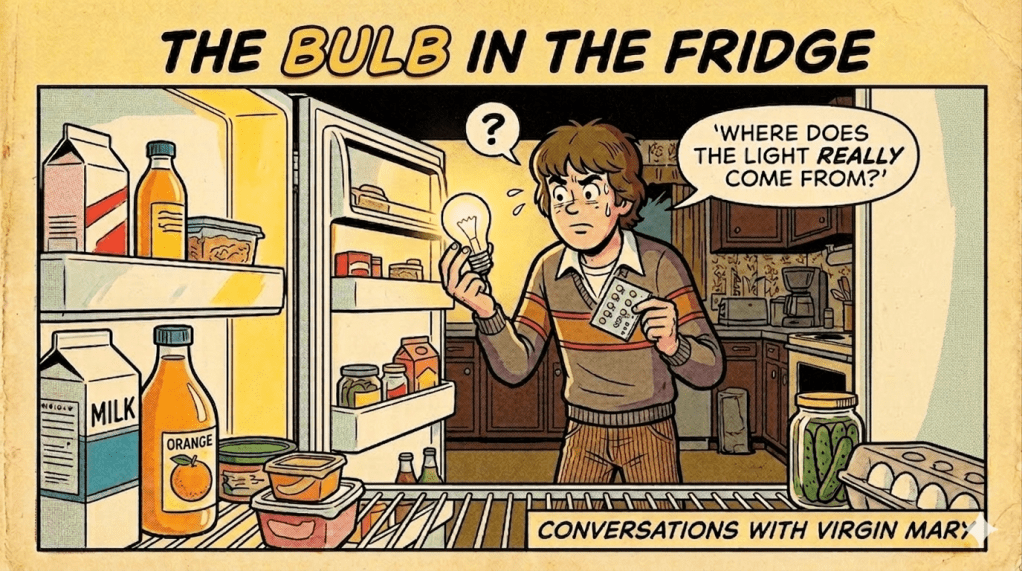
Conversations with Virgin Mary
I took my car to the body shop to repair the antenna and the hole in the roof. I don’t need a radio in my car. I can live without it, but the hole in the roof is keeping me awake at night.
There are features you take for granted until they fail or disappear entirely, like the radio antenna, and by extension, the radio stations themselves. Right now, the only radio I own is integrated into the car. I do not have any other device capable of tuning FM or AM. I doubt my son even knows what those initials mean anymore, or what their purpose once was.
You do not need a radio to commute from point A to point B. It is convenient, but not necessary.
My brother from Alberta is coming to visit. Well, not exactly to visit me. He needs to complete some paperwork at the Spain Consulate, but he will stay at my house for a few days.
The timing is good. We need to talk face to face about my mother and what should happen next. At eighty-seven, it is difficult for her to remain alone.
What is better for her now? A nursing home or her own house?
There is a serious conflict with my former sister, the only one of my mother’s children still living in Guadalajara. She says she is exhausted and sick, and wants to move my mother into a nursing home.
I think constantly about my mother, her house, and her stubborn refusal to leave it.
Objectively, it would probably be safer for her to live in a nursing home surrounded by doctors and nurses specialized in elderly care. But the house has become part of her.
My mother was not born in Guadalajara. She was born in Veracruz and studied in Mexico City. She only moved to Guadalajara in her forties when my father’s job transferred us there. Most of her children no longer live there either. There are no real roots for her in that city.
And yet the house itself became the root.
Sometimes I think the house is attached to her like a tumor. Removing it might save her, or it might destroy her completely.
It has been a difficult year trying to care for my mother from a distance. I cannot remain with her permanently, and she cannot immigrate to Canada. The restrictions for elderly people are too strict.
That was the story I told Jorge this week.
I stopped at Starbucks and bought two Iced Mango Cream Chais, the beverage of the month, before driving to his house.
We were sitting at the kitchen table discussing my mother and her daughter when Jorge reached into a folder and pulled out a random page.
Sunday, February 7th
Do you know that the bulb inside the fridge was not an original feature in the first refrigerators?
The refrigerator evolved from a small cold-making machine in the 1930s into a display case for curated meals. And because people changed, the way the appliance worked also changed.
Imagine living in the 1930s. Electricity was unreliable and, in a certain way, scarce. That was the world where the first commercial refrigerators appeared.
There was no need for a light inside. You opened the door, took what you needed, and closed it quickly so the machine could preserve the cold and keep the electricity bill low. Compressors were inefficient, so it was better to avoid opening the fridge more than necessary.
By the 1950s, refrigerators had become common in homes, and the incandescent bulb became a standard feature. During the 1970s, plastic diffusers softened the light and distributed it more evenly inside the compartment, although it still came from a single source.
Then, during the late 2000s and early 2010s, LEDs started replacing incandescent bulbs. Their small size made them easy to install all around the refrigerator. Suddenly the light was everywhere. The fridge began to resemble a shop window more than a cold storage device.
The needs of people changed with industrialization, and with them, the way the house was used and the appliances inside it.
In practical terms, you do not need light flooding every corner of the refrigerator to grab two slices of bread, some ham, and cheese. The main purpose of a fridge is simply to keep food cold.
Now imagine this:
The light starts to fail.
Even LEDs have a limited lifespan. They are not eternal, and certainly not failure-proof.
The light begins blinking intermittently. The convenience of having illumination everywhere suddenly becomes impossible to ignore.
You probably never check whether your refrigerator is actually cold enough. Do you even keep a thermometer inside it?
But light is different.
When the light fails, you notice immediately.
You decide to replace it, only to realize there is no single bulb anymore. There are multiple light sources failing at the same time. You wonder why they all stopped together. Then you learn they are connected in series, so if one fails, the entire system fails.
Now the replacement is no longer a simple Edison screw bulb. It is a collection of LED boards hidden behind panels that are difficult to reach and difficult to replace.
A feature that was never part of the original purpose of the refrigerator — and not even necessary for keeping food cold — suddenly keeps you awake at night.
You only open the fridge a few times a day. You could leave it like that forever, and the refrigerator would continue working normally.
But now this tiny failed feature occupies your thoughts.
How can such a small part of a system distract you from its main purpose?
Maybe because the main purpose never disappeared. It simply became buried beneath layers of convenience.
“Yes, this problem is like the bulb inside the fridge,” I said. “We didn’t take care of it. We didn’t even know it existed until it started to fail. What now? Should I replace the bulb? Should I replace my mom?”
Jorge took his plastic cup and studied the colours of his drink. He moved his head slightly, in disapproval, then paused.
“You haven’t understood anything,” he said. “These letters are not an instruction manual. I’ve said that a thousand times. This is a map. A map does not tell you what route to take. It shows you where you are, and where your destination is.”
“Yes, a map,” I replied. “I’ve been following the map, and now I’m lost in a backstreet with no light and no idea how I got here. And Virgin Mary keeps insisting on her cryptic messages. I don’t understand her maps. Maps are not for me. I need clear advice.”
“What is clear,” Jorge said, “is that your mother is getting worse every day. And it is not anyone’s fault. It is not your mother’s fault, not yours, not your sister’s. It is natural. You have to accept that your mother is dying, and nothing will stop that.”
He placed the cup down.
“You, your brothers, your sister—you all have your own lives too. It is good that you take care of her, that you give her attention, but you also need to take care of yourself. Your wife. Your son.
You need to stop turning your sister into the enemy just because she refuses to carry the same weight in the same way you do. Everyone deals with it differently.”
He finished his drink.
“The Virgin Mary letters are a map,” he said again. “Whether you like it or not. Pay attention to where you are. It is good that you care about your mother. It is good that you want the best for her. But you also need to focus on your own direction.
Your work. Your submissions. Your next show.
If you are stable, if you are moving forward, that will reach her more than anything else. More than money. More than guilt.”
He leaned back slightly.
“That will help her more than trying to fix everything at once.”
That was not the answer I expected. It never is.
I always arrive with a ready-made conclusion, hoping that Jorge—and Virgin Mary—will confirm it.
But it never works that way.
It is like I go to him expecting to change the bulb, and he tells me the problem is not the bulb at all, but the switch.


Leave a Reply