Conversations with Virgin Mary
This afternoon I arrived at Jorge’s house with my homework done, that was the feeling I had, accomplishing on avoiding one of my many cases of procrastination, finally I completed and submitted an application for a grant in the Canada Council for the Arts, I have been tracing a plan about a new series of drawings and essays paired together. The essays are a new interpretation of Sun Tzu The art of the War, not as a manual for generals but as an artist guide for surviving, each chapter will be paired with a series of drawings that, as a rebellion counteract, are drawn on my own rejection letters. It’s like giving advice about being rich while you’re on bankruptcy or an AA meeting sponsored by a Budweiser. My own contradictory way of walking into the art world.
I arrived at Jorge’s house and before I could knock the door Jorge opened it and said: “I’ve been waiting for you, please come with me, I have to pick up my correspondence”.
We walked to the corner and turned to the right, in front of the parking lot for the soccer fields, in the middle of the block there’s a community stand for mailboxes and that’s where Jorge has his mailbox.
There was a sign in the side of the cabinet, a cat poster, it reads “Missing cat”, and a photo of the cat in question, a tuxedo cat and below: “Please help Virgo come back to home”
“Hey, that’s Virgo! She’s lost, maybe she went hunting and got lost.” I said, worried about a cat that has been part of our conversations since last year.
Jorge, looked at the poster, picked up his correspondence, closed his mailbox and walked away without saying a word.
We were walking back to Jorge’s house when I asked: “Why you didn’t say anything about Virgo? Aren’t you worried?”
Jorge was serious and he just said: “That cat is never lost, the owners are clueless”.
We arrived at his house, and Jorge started to fill the kettle with water to prepare tea. Then suddenly, out of nowhere Virgo appeared in the living room, meowing.
I didn’t expect her presence there after the poster in the mailbox so I started to wonder, “Virgo is here, and you know it, why you didn’t say anything?”
Jorge was preparing tea with all the solemnity that characterized him, he stopped doing the task and faced me, “She doesn’t want to leave, I don’t know what to do with her”
“Doesn’t want to leave? What does that mean?”
“Hey, this cat is wiser than you think. She asked me to give you a message.”
The cat answered with another series of measured meows.
To my astonishment, Jorge nodded several times during her speech, interrupting only once, as though asking for clarification on a point of etiquette.
Then, Jorge went directly to his office and pulled out his folder with the Letters from Virgin Mary.
Jorge started to look for something in the folder, “Yes, I know, I have it here, hold down” He was actually talking to the cat.
“Here it is, this is the letter, now I can continue preparing the tea. No more interruptions.” He said and handed it to me.
Tuesday, March 18
This is not another aphorism that requires your abilities for decrypting hidden meanings. This time, I have a lesson for you.
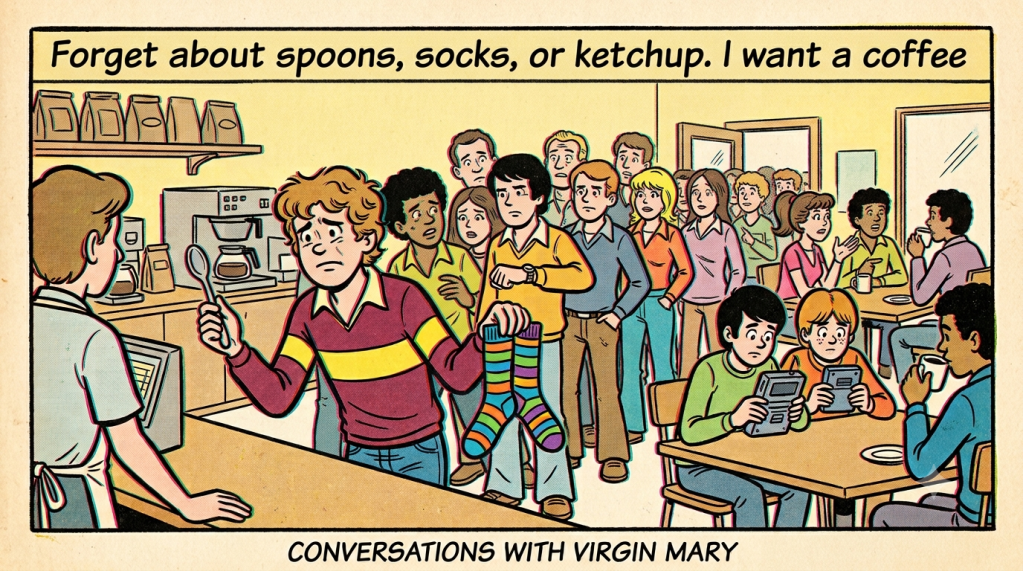
Forget about spoons, socks, or ketchup.
I know you are curious about visualization. I know there is a great deal of misinformation surrounding it. All these new era books about quantum physics, and the descendants of Napoleon Hill’s Think and Grow Rich, have done more damage to visualization than they intended, because they misunderstand it.
They believe that if you place an image in your mind and hold it there long enough, reality will immediately rearrange itself to fulfill it. Then, when nothing happens, they blame the mind for focusing on scarcity, problems, and fears instead of solutions.
There may be some truth in that interpretation, but it is incomplete.
An architect visualizes a building first in his mind. He can almost see it completely: its proportions, its spaces, the way people will move through it. But then he must transfer that vision into drawings so others can understand it and transform it into reality. That process requires time, effort, and resources.
The same happens with your ideas.
Once an idea exists in your mind, you must transfer it to paper. You need a plan, a description, drawings, and instructions. A small house of 1,500 square feet may require more than one hundred blueprints because the architect must communicate the idea to everyone involved in the construction: carpenters, electricians, plumbers, engineers.
The image in your mind is only the beginning.
Many people remain there. They create visions, repeat affirmations, and wait for the world to deliver what they imagined. When nothing happens, they believe they failed at visualization.
No. The problem is that they never built the bridge between imagination and reality.
Let us use something simple. You want a coffee.
You create the image in your mind: a warm cup, the aroma, the first sip. But nobody knows what you want. Nobody can read your intentions. You are not even standing in the right place to receive it.
The image is necessary, but it is not enough.
You need a blueprint.
If you want coffee, create a path: go to a coffee shop, choose the type of coffee, decide when you will go, determine what you need to do. If you are standing inside a toy store, you may have a strong desire for coffee, but your actions are not aligned with that desire.
Write it down.
“I want a coffee.”
Good. Now be precise.
What kind of coffee?
“I want 40 milliliters of an espresso shot made from Colombian Supremo beans, served in a Blue Willow cup.”
Now the desire has form.
This is what an architect does. An architect does not write: “I want a wall here.”
He specifies:
“There will be a wall made of lumber, covered with drywall, fifteen centimeters wide, extending from point A to point B, with a height of 2.4 meters.”
Precision transforms an idea into something that can be built.
I hope this is clear.
Now it is your turn.
Your task this week is simple:
Visualize.
Choose something you desire. It may be related to health, money, career, love, or anything else. Nothing is impossible to imagine.
But do not stop at imagination.
Create the image. Hold it in your mind. Then write it down. Create the steps. Draw the blueprint.
Will it manifest?
I do not know.
That depends not only on your desire, but on your willingness to participate in its creation.
And this time there’s no messenger; your messenger will be the fulfilment of your desire.
Jorge poured the tea into two cups and placed the timer beside them. Then he pushed one of the cups toward me and waited.
“I don’t understand. What is this all about?”
Jorge looked at me with a mixture of surprise and concern.
“The tea?”
“No, not the tea. The letter. Why did you give me this letter? Why now?”
He looked at the cup as if it contained an answer I had overlooked. He observed the color slowly changing, the steam rising, the leaves releasing their final secrets into the water.
“I thought you knew,” he said. “I am only fulfilling a request from Virgin Mary.”
The timer rang.
“Ah, the tea. Take the bag out and place it on the saucer. Do you want cream or sugar?”
“No, thank you. I don’t even know if I want tea right now. The letter is talking about coffee.”
Jorge smiled and lifted the cup toward his face, appreciating the aroma before taking the first sip.
“Well, I don’t know what your thoughts are,” he said. “Did you write them down? Did you make a plan?”
He was completely absorbed by the ceremony of the tea.
Then he placed the cup on the table and looked directly at me.
“Do you know the difference between you and me right now?”
I waited.
“I wanted tea. I really wanted this moment. The idea came to me this morning. Then I prepared everything: the ingredients, the dishes, the kettle. I even filtered the water. I followed a plan, and now I am enjoying the result.”
He pointed toward my untouched cup.
“You, however, are still deciding what you want. Tea or coffee. This open call or the next painting. One direction or another. Your problem is not that you have no desires. Your problem is that you have too many possibilities and no map.”
He took another sip.
“Clear your thoughts. Make a plan. That is all. Now tell me: what do you want?”
“I don’t know. I need to think about it.”
He smiled.
“You see? You don’t know what you want.”
“It’s not that simple. I want many things. I want my mother to recover from Parkinson’s, but I don’t know what I can possibly do. There isn’t a plan for that. Nobody knows one. In my career, I want to exhibit my work in London. I want a curator to choose me for an exhibition, but that isn’t simple either. There are gatekeepers everywhere. You have to know the right people, and I’ve never been good at meeting new people.”
Jorge nodded.
“There. Don’t you see? You do know what you want. For the Parkinson’s you need the cooperation of your mom, you are limited by her willingness, you have a narrow window to act. On your career the problem is different, you’re afraid of ghosts, of something that hasn’t happened, make it happen and then if something goes wrong you make another plan.”
I remained silent. I looked at the cup in front of me, then at Jorge. He was right.
After a moment, I asked:
“What is Orange Pekoe? Is it related to oranges?”
Jorge laughed softly.
“No. Orange Pekoe has nothing to do with oranges. Nobody knows for certain, but one theory says the leaves turn coppery-orange through oxidation and drying, and that’s where the name comes from — not the fruit. It’s a classification, not a flavor. Every tea has its own history, its own journey, its own origin.”
I looked at the cup again.
“Then I have a request. I want to learn about teas. Can you teach me?”
Jorge smiled.
“You see? Now you have a plan.”


Leave a Reply