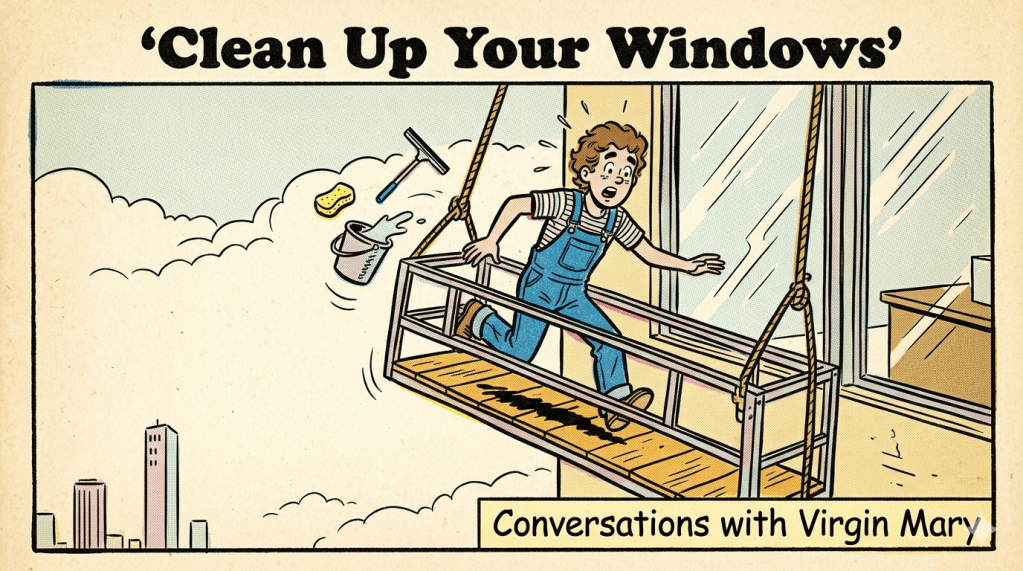
Conversations with Virgin Mary
I saw a chicken trying to cross the road, just like in the videogame. There were no cars, only mine, slowing down. I think it was a chicken, the window was so dirty from the melted snow on the roads.
What was a chicken doing there?
I live on the rural edge of the GTA, within the Greenbelt—a low-density stretch where farms still interrupt the logic of the city. Seeing animals is not unusual. I’ve come across sheep, wild turkeys, foxes, coyotes, geese, swans, raccoons, even turtles. So, the presence of a chicken, in itself, wasn’t entirely out of place.
But the timing was so right.
It came from an unexpected place and just after I bought the chicken livers to prepare Virgin Mary’s task, I ordered them from a farm in the region.
I drove home.
Last week I tried to avoid any contact with Jorge, I was busy planning a trip to Alberta and trying to rent the new condo that my wife and I bought in February, but I was still trying to do the task Virgin Mary was asking, I closed the curtains, I needed no distractions.
I was about to wash the livers when the doorbell rang. I went to the door, quickly, but no one was there. Only Virgo, the cat, sitting on the porch, and an envelope with my name on it.
I bent down to pet her, but she meowed sharply and ran off.
The street wasn’t empty. A neighbor waved. I waved back, but I didn’t say hi. I was not in the mood for conversations, so I cut it there.
Then I picked up the envelope, went inside, and opened it.
It was another letter from Virgin Mary.
Sunday, October 19th
Do you know that window comes from Old Norse vindauga, which literally means “wind-eye” (vindr = wind, auga = eye)?
It’s a poetic solution about an ancient problem. All began when primitive man moved from caves into constructed spaces—artificial caves of his own making. A solid wall offers protection, but it also blinds. From inside, there is no way to know what waits outside: danger, the right moment to step out and hunt or gather.
So, he needed a wind-eye. A window.
Not so others could look in, but so the inhabitant could look out.
Two needs: protection and awareness.
But time passed. There was no longer a need to hunt, no immediate threat of wild animals—at least not in the city. The window remained, but its purpose began to fade or change.
Have you looked through the window lately? Yes, you haven’t hunt either.
This is not a joke, I’m serious. When was the last time?
You are focused so much inwards that you take for granted what’s outside. It’s not interesting, you say. It’s distractive, you don’t have time to see outside. More than once, you are thinking on sealing them with aluminum foil, shut them down. Artificial lights will replace sun, it’s consistent, you can also have it at night. And you think that’s the right way to be, the more efficient way to live, with no distraction. So much that that you haven’t cleaned the windows for years.
And little by little, you close yourself off.
Your neighbor is taking his kids on a bike road, teaching lessons in the outside, the waitress of that Japanese restaurant that you like so much is walking her dog right now. Collin and Melissa are taking their kids to soccer. Even that annoying tuxedo cat of the neighbor is taking a sunbath at your porch, but you remain focused on your own thoughts.
This is where you arrived. Yes, you needed protection and being alert.
Well, I’m going to ask you to reconsider, don’t be afraid of the outdoor life, peek, it’s OK.
You built walls for protection. That made sense.
But you also closed windows—and that was never the intention.
I need you to do something for me. Clean up your windows. Take all the obstruction out of the window, no stickers, no foil, no dust, like a spring cleaning, and open the curtains, let the light pass through.
Let the air move through your house. Look outside. Look at the trees, the birds, the passing moments you’ve been missing. Let the windows be your Wind Eyes.
That is your task.
I will send you a messenger after that.
“You know, shutting the windows is part of my story. Probably unconscious,” I told Jorge the next day when I visited him.
He was in the kitchen, cutting chunks of a green fruit, white on the inside. “I see,” he said. “You’ve been ignoring me all week.”
I stayed silent for a moment, then deflected. “What are you preparing this time?”
He hesitated. “I found this soursop at the supermarket and decided to make—what do you call it? Soursop-ade? I call it Cloud Drink. You’ll see what I mean.”
“Oh, I see—guanábana,” I said. “That was one of my favorite memories from my grandparents’ house. They lived in Veracruz. My grandfather had a guanábana tree in the yard. But I’ve never heard anyone call it ‘cloud drink.’ Still… I understand the comparison.”
Jorge nodded. “Yesterday I sent you the letter about the windows. I thought this might be a good excuse to talk about them.”
I hesitated, then said something I rarely admit. “My wife’s father was killed thirty years ago. He was leaving his office at night. Seven bullets in the back. The police never found a suspect, but we always believed it was someone close to him—someone who knew his routine. After that, my wife began to see a threat in every new person.”
Jorge kept working, but when I reached that part, he stopped and turned to face me.
“When I realized it,” I continued, “I was doing the same. Not inviting people. Avoiding any kind of social connection. Covering the windows so no one could see inside—but also, without noticing, I stopped looking outside myself.”
I paused.
“In part, leaving Mexico came from that. We didn’t want that life for our son. That’s why I never went back. I was done.”
Jorge turned again, pouring the drink into two glasses. “Here,” he said, handing me one. “Look at the clouds. You see what I mean? Go on—drink.”
I took a sip. The taste brought me back immediately—to my grandparents’ house. It was a place where nothing could happen, where I felt completely safe. I remembered my grandfather’s library, the books he lent me: Michael Strogoff, Captain Hatteras, From the Earth to the Moon. He loved Jules Verne. All his stories were about traveling—about going out into the world in search of something unknown.
“My grandfather had a large terrace,” I said. “I used to sit there in the shade for hours, reading, drinking guanábana juice. This… this is exactly that.”
“Good,” Jorge said. “Then let’s not stay inside.”
He smiled, almost casually. “The snow is gone. It’s sunny. What do you say—shall we take a walk along the trail? It’s been a while since I’ve been on it.”
We reached the pond when Jorge suddenly stopped. “Did you hear that? A blue jay—over there, in that tree.”
I followed his gaze. A moment later, I saw it.
We kept walking. After passing the pond, he stopped again. “Now it’s a woodpecker. Let’s find it.”
He followed the sound—steady, insistent knocking—until we reached a pair of trees still bare of leaves. He looked up and pointed. At the top of one of them, the woodpecker worked the trunk.
“He’s making a window in his new home.”


Leave a Reply