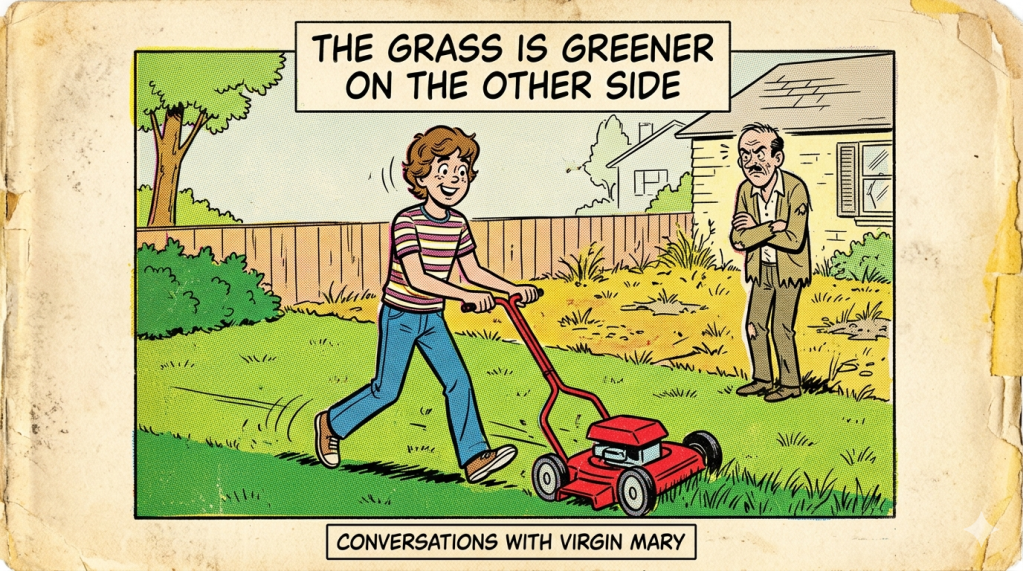
Conversations with Virgin Mary
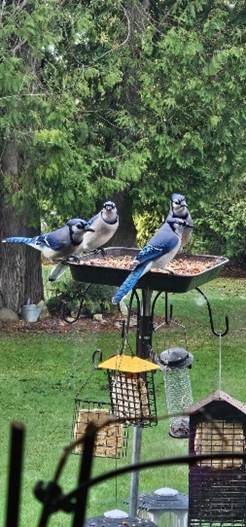
My boss sent me a couple of pictures through WhatsApp. They were taken from his window: a group of blue jays gathered around a feeder. In the next image, a woodpecker appeared. The last one was a video. The same birds Jorge had pointed out to me before my trip, when we walked the trail together—only now, seen through a window.
I was in Grande Prairie, Alberta, reviewing our account with a customer. A thousand miles away.
When I returned home, I dedicated Sunday to cleaning the garage. The sand that had accumulated over the winter needed to be cleared out.
I was in the middle of it when Jorge arrived. He saw me, picked up a broom, and began to help. The work became easier with two people, but more importantly, he showed me something new: how to hold the broom properly, why different brooms exist, and a simple trick to gather dust more efficiently—damp sawdust.
I didn’t have sawdust in the garage, but my neighbor, a carpenter, might. Yes, the same neighbor that a week ago I refused to talk to and only wave back. Now I have to swallow my pride and ask him for some sawdust.
I got a small bag, and Jorge dampened it before spreading it across the floor. Within minutes, he was sweeping up far more sand and dust than I had managed on my own.
When we finished, I invited him for a drink.
“I have tequila, and also this mezcal from Oaxaca. Do you want to try?”
“No, thanks. Not this early. I’d prefer water.”
“Ah, I have something from Mexico,” I said. “Agua de Jamaica, hibiscus tea”
“Jamaica or Mexico?” he asked.
“It’s a traditional drink in Mexico,” I replied. “I’m not sure where the name comes from. Maybe the hibiscus was brought from Jamaica.”
“You’re not far off,” he said. “Hibiscus comes from West Africa—called bissap in Senegal or zobo in Nigeria. It was brought to the Caribbean during the transatlantic slave trade, and from there to Mexico. It became a common trade from Jamaica, which is why it carries the name. A small example of how cultures move and blend.”
“How do you know all this?”
He shrugged. “I carry around a lot of useless knowledge. It’s good for conversations, not much else, the same as how to broom or use sawdust.
Tuesday June 6th
Mowing grass is a meditative chore; you do it almost unconsciously while your thoughts are wandering toward things that seem to demand more attention.
It is something that you have been doing since you’re a kid. It’s so embedded in your routine that you don’t need to consult a manual or watch a YouTube video to perform the task. Who’s going to have more experience than you on this, right?
But experience and repetition are not the same.
The difference is knowledge. You can perform a task over and over again without knowing what you are doing or having a limited knowledge of the task.
Have you thought about exchanging knowledge with your neighbor? Have you heard the idiom: “The grass is always greener on the other side”, Whether or not it’s true is beside the point, but maybe, just maybe the grass is greener because your neighbor know something that you don’t know, they may fertilize differently, or use a different type of seed, water at specific times, or mow at a different height. Small variations can lead to visible results. Your neighbor knows something that you don’t.
You are not an expert on grass—and even experts don’t know everything. Why would you need to understand tropical growth patterns when you live in Canada? Still, there is always something to learn within your own conditions.
Make a list of the steps that you perform while mowing grass, also timing, frequency and every small detail. Keep a log of it.
The more conscious you become of the process, the more your knowledge will grow—and you will see that reflected on your grass. Haven’t you thought before that knowledge can improve something as overlooked as the color of your grass.
Team up with your neighbor and exchange information, is not only good for your grass, it will also strengthen your awareness and improve your relationship.
I have a task for you this week, talk to your neighbor about the problems that you experience. Share what isn’t working. Ask what has worked for them. You may discover that both of you are uncertain, but that uncertainty, when shared, becomes a starting point.
After you complete your task, I will send you a messenger, a messenger that will remind you that “The grass isn’t always greener on the other side”.
I left the letter on the table and took a sip from my glass of water. Through the window, I looked at the grass in my garden—it needed a trim. Then I began.
“I once worked on a project in Guadalajara,” I said. “A renovation—more like a transformation. An old AT&T factory had to be converted into a private college: classrooms, parking, washrooms. My team won the contract, but we had to coordinate closely with the construction company.”
“I was responsible for the blueprints and documentation. It was my first time collaborating with another firm, and they kept asking for more and more specifications—doors, lighting, windows—before anything could begin. I found it exhausting.” I fidgeted with the letter. “I complained constantly. My partner wasn’t much help—he struggled with alcohol and was often unavailable. It felt like we were drowning in paperwork. I didn’t want that. I wanted to be on-site, directing the work, overseeing the building. I think I was jealous. In Mexico, architects often handle both design and construction.”
Jorge listened quietly. “You were avoiding collaboration,” he said.
“Yes,” I replied after a pause. “I see that now. I lacked experience, and I was afraid—afraid of being questioned, of not knowing the answers, of being judged by my peers.”
I leaned forward. “Then one of the engineers proposed a change to the parking lot. It would only add a few spaces—no more than five—but it required rethinking the entire layout: a new entrance, new circulation, a more complex flow of traffic. That’s when I pushed back. I told them this wasn’t a trivial adjustment, that every space had a reason to exist.”
I brought my hands together. “In that moment, I set my boundaries—but I also had to accept theirs. That’s when I learned something important: their experience mattered. If I took it seriously, I could become a better architect. You can learn from anyone—your collaborators, your counterparts, even those you resist.”
I paused, looking at my half-empty glass. “That project led to more collaborations. We designed classrooms, even entire schools together. But I began to notice something with the client. Even when I specified critical elements—fire-rated doors, emergency exits, sprinklers—they were often removed to cut costs. So why insist on detailed specifications if they wouldn’t be respected?”
I exhaled. “The breaking point came with a football field. They asked me to follow NFL standards, so I brought in a specialist and developed detailed plans: dimensions, drainage, artificial turf—everything designed to protect the athletes. After all that work, the budget committee cut the specifications again, compromising safety. No fireproof doors, no proper emergency exits, and now unsafe turf. That was it for me. It was my last project with them.”
I glanced toward the garden. “Their grass wasn’t as green as I thought.”
Jorge stood and walked to the garden door. He looked outside for a moment before speaking.
“Well,” he said, “now you need to apply that same courage. Go ask your neighbor about the grass. Maybe he’s doing something different—sawdust, watering patterns, who knows”.


 Carlos Fentanes
Leave a comment