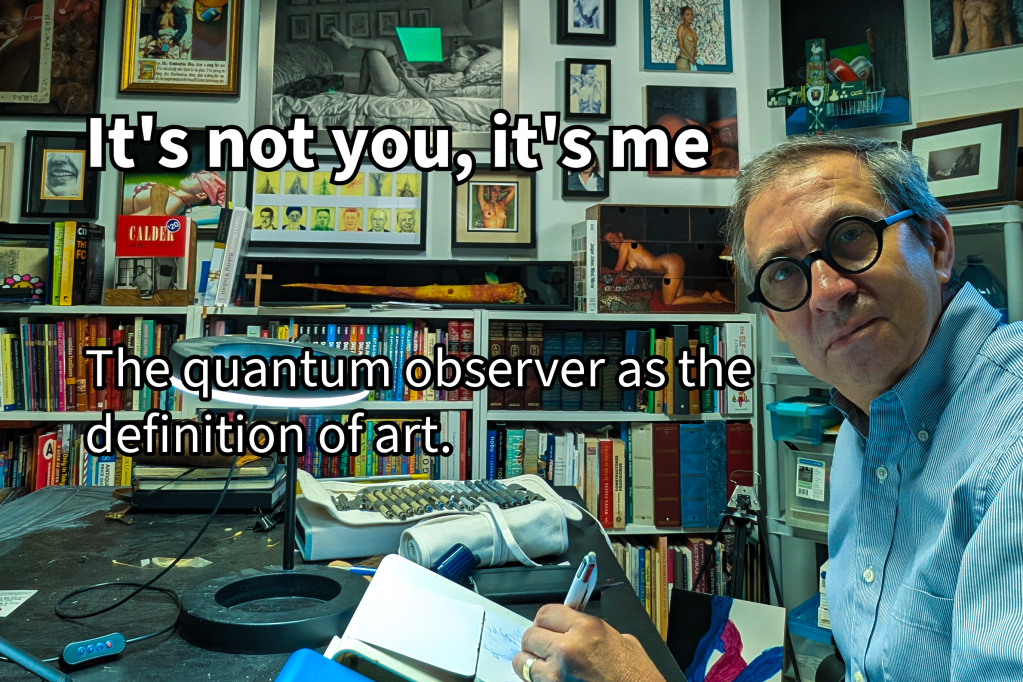
The quantum observer as the definition of art
When I was younger, in high school, I started to realize what was the art world, I made my first Art essay, mostly copied from other authors. And for the first time I wondered what was art.
As a young student with no life experience I, intuitively, linked art with beauty, I think that my first definition of art was about the emotion of beauty, if it’s not beautiful then it’s not art.
Studying architecture, I learned that beauty had been deliberately abandoned. The Bauhaus, Mies van der Rohe, Le Corbusier — all of them stripped away ornament in pursuit of simple lines, as if beauty no longer mattered. But in doing so, they found something else: an aesthetic that didn’t depend on beauty at all. Walking through Barragán’s houses years later, I could feel it — these were not beautiful buildings in any conventional sense, yet they were unmistakably aesthetic.
That was the shift. Art wasn’t about beauty. It was about an aesthetic decision — deliberate, purposeful, even when the result was austere or ugly.
My first years into an Art Gallery
Right after university, a young gallerist saw my paintings and added me to his roster — Oscar Roman, a gallery rooted in the Mexican School: Rivera, Kahlo, Tamayo, Toledo. Figurative work, brilliant color.
The clients were collectors in their early stages — comfortable, not wealthy, building their first collections. And there I learned something my architecture training hadn’t prepared me for: art could be named art simply because of who made it, or which collection it entered. Beauty, aesthetic intention — none of that was the deciding factor anymore. A notebook page with a few doodles and a signature could be the centerpiece of a collection.
La Biennale
One trip took me to Venice during the 50th Biennale, and it was overwhelming — Murakami, Saville, Schnabel, Close, Hirst, all in the same afternoon. I bought the catalogue to slow it all down, to actually study what I’d seen.
Of everything in that book, one work has stayed with me for twenty years — and it wasn’t in the main exhibition at all. It was in a section of rejected proposals. An artist — I’ve long since forgotten the name — had proposed a performance: he would visit the Giardini disguised as an ordinary tourist, maybe bring his family, and simply walk through the pavilions unnoticed. The entire piece was that nobody would know an artist was performing.
My first reaction was almost a laugh — is this even art? But the more I sat with it, the more precisely structured it seemed, right at the edge of absurdity. I have no idea whether it was ever performed, or whether “rejected” meant it never happened at all.
And that’s exactly the point. Of everything I saw that week — Murakami, Hirst, the crème de la crème — this is the piece that survived in my memory. Not because it was beautiful, or aesthetic, or attached to a famous name, or sitting in an important collection. It was art without any of the things I’d previously decided art needed.
Brian Eno
Brian Eno — musician, producer, and one of the more interesting art theorists working — once told a story (I’m paraphrasing from memory) about a rock critic who received an advance copy of Lennon and Ono’s Two Virgins. The first track on the tape wasn’t part of the album at all — it was a calibration track, the kind of noise engineers use to set up equipment, never meant for release. The critic, not knowing this, heard it as the opening statement of an experimental record — looping, electronic, deliberately abrasive — and wrote about it as a brilliant piece of avant-garde composition.
Lennon and Ono never knew the track existed, let alone that it had been attributed to them as art. But it was on their tape, sent from their label, under their names — and that was enough.
Quantum Art
Everyone knows the double-slit experiment: the act of observation changes the nature of the electron, collapsing it from wave to particle. I’ve watched the same thing happen with art.
The moment someone asks “is this art?” — the object changes. The question itself is the observation. And here is where it gets strange: even rejection completes the act. A viewer who decides something is not art has looked at it with the precise attention that makes it art. The object becomes art in spite of them, or because of them.
Which leads to the only definition I’ve been able to land on after all these years — Barragán’s houses, the Oscar Roman collectors, the rejected performance proposal in the Venice catalogue, the calibration track on a Lennon tape: art is what is observed as art. A circular definition, yes. But perhaps that circularity is the point — the electron doesn’t know it’s being measured either.

 Carlos Fentanes
Leave a comment