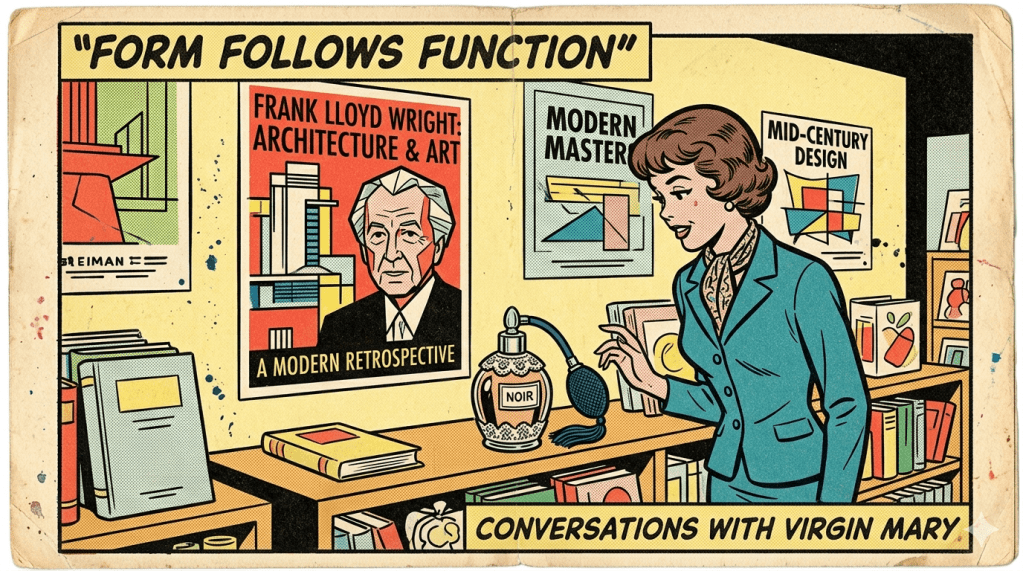
Conversations with Virgin Mary
I returned home from Milwaukee. I had time to visit the House and Studio of Frank Lloyd Wright in Chicago, and Taliesin, his cottage in Wisconsin where he lived for 50 years.
It was an interesting visit, almost like archaeology—uncovering the past, even if it is a relatively recent past.
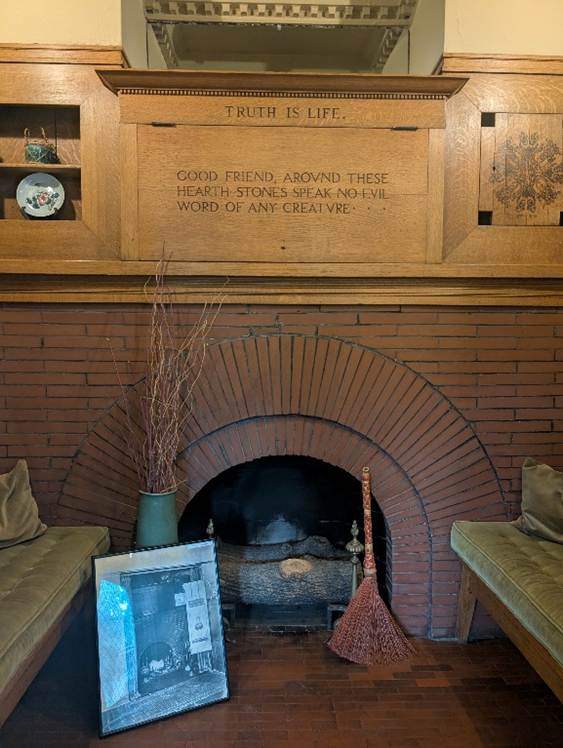
I remember my time in architecture school. There was a myth around Frank Lloyd Wright. My professors told us the legend that he never wanted to design kitchens. He always left them as empty rooms: no furniture, no countertops, no space for a fridge or an oven.
Later I realized the house was built in the early 1900s. There were no refrigerators, no electric ranges, no custom kitchen cabinets. It was another time, with different rules for designing a kitchen. In fact, the kitchen contained doors leading to something closer to storage than a modern fridge—wooden cabinets for cooling shelves, with a special space for ice. You had to subscribe to an ice delivery service, and every morning an ice truck would drop a large block of ice for that cabinet.
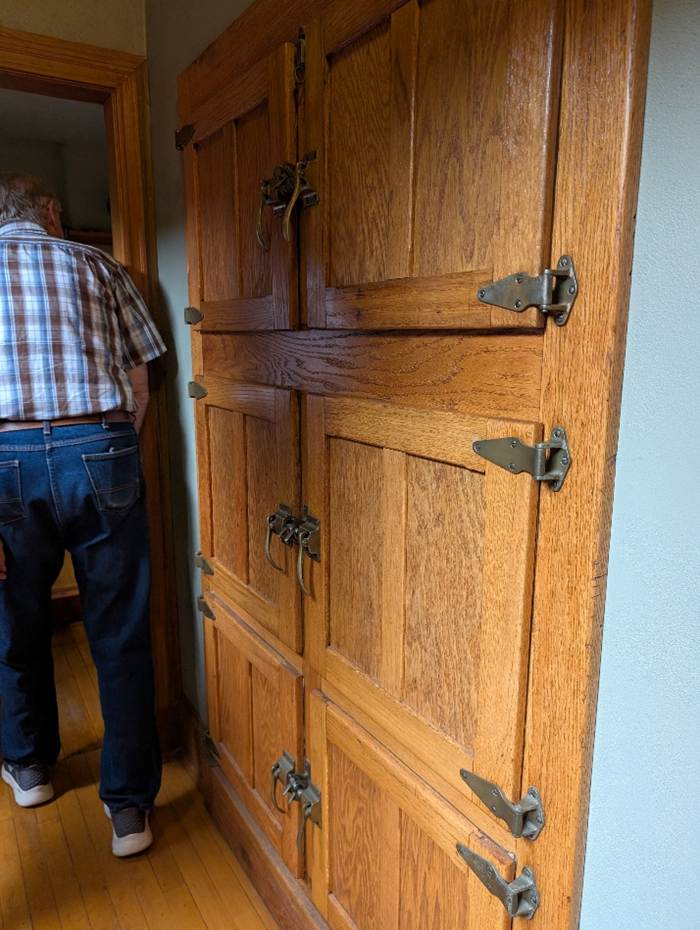
It was not an appliance like nowadays; it was part of the room itself, part of the cooking zone rather than a kitchen as we understand it today.
It is as if I were to ask where Frank Lloyd Wright would place the internet hub, and then wonder why he didn’t design a cabinet for it.
I realized my professors were telling us a story to hold our attention—a fictional story, far from reality. It was not about truthfulness. History is often a way of constructing narratives rather than reporting facts.
I bought a teacup in the style of Frank Lloyd Wright for Jorge in the gift shop. I went to his house under the pretext of delivering the teacup.
It was a sunny day, and Virgo, the tuxedo cat from his neighbour, was on the porch as usual, sunbathing. She meowed at me and I tried to pet her. Then I noticed her tag. On one side it read her name: Virgo. On the other, it said “IS Mariam Saint.” I didn’t have my glasses with me, so I took them out and read it again: it was the address—of course: 15 Mariam St.
Jorge lived on Mariam Street. I should have expected the cat’s tag to carry a Mariam Street address.
The cat disappeared the moment I knocked on the door.
Jorge opened it and invited me in. He looked at me and said quickly, “Good to see you here. I have something to share with you. Let’s prepare some tea.”
Wednesday, August 8th
What is the true purpose of a bottle?
A perfume bottle should simply be a vessel for holding a small amount of fragrance. But because perfume is expensive and the quantity is tiny, the object must create the illusion of abundance. The walls of the bottle are thicker than necessary, making it seem as though there is more inside. Then the surface is decorated with flowers, bodies, jewels, and symbols of luxury.
Finally come the names, titles often completely disconnected from the content itself: Fleurs du Mal, Orgasm, Sex on the Beach, Pheromones. The more absurd the name, the more successful the illusion.
The bottle is no longer just a container.
The entire product is built around an imagined version of who you are supposed to be.
“Form follows function” is not applicable here. Please be advised that this is a deceptive exercise. Do not theorize about design principles.
Now compare it with a jar of medicine. The container is small, probably plastic, and instead of an exotic name there is information: formulas, instructions, measurements. Medicine demands precision and clarity, not vagueness.
Perfumes rarely contain this kind of information. No formulas. No ingredients. No instructions. Only atmosphere and suggestion.
Your task this week will be to visit a perfume store and test every bottle you can find. Examine the shapes of the bottles. Read the names carefully. Make a list of them and arrange them by price.
What is the purpose of this exercise? Nothing. Nothing in particular. I simply want you to realize that you do not need perfume at all.
I will send you another message once you complete the task, in the form of a perfume bottle.
I read the letter while he was preparing tea.
“What does this mean?”, I asked.
Jorge was in the kitchen, working with the kettle with the precision of a laboratory technician. He measured what I assumed was tea and poured it into the teapot.
“I think the purpose of the letter is quite clear: deceptiveness. We tend to arrange and decorate what we do so that no one notices our own failure,” Jorge said, turning on the heat.
“Yes. Architects cover their mistakes with plants.”
He smiled at the example. “Exactly. Like the perfume bottle.”
“I’ve started a project about my failures in submitting art. I draw directly on rejection letters. I’m decorating my own failures.”
“Ha. You’re making your own perfume bottle—denying reality with a drawing. That’s clever, but remember it doesn’t change the fact that you were rejected. Someone looked at your work and decided it wasn’t enough to hang on their walls.”
The kettle began to whistle. Jorge turned off the heat and let it rest for a few minutes.
“I wear these rejection letters as badges. It hurts to be rejected, I know—but it’s proof that I tried, that I finished the work and sent it into the world.”
Jorge poured the tea. He gave me a teacup from his pantry and used the one I had brought for him.
He looked at the motifs on the teacup, at the earth-red glaze. Straight lines formed an abstract pattern in the style of Frank Lloyd Wright, but it was clear he hadn’t designed it. It was only a souvenir from the gift shop—deceptive, if one thinks about it.
Jorge examined the teacup silently before speaking, “Gift shops tend to simplify people into motifs. Frank Lloyd Wright reduced to abstract lines. Wright was more than these decorative patterns. You are also more than your rejection letters.” He pushed my teacup toward me. “You have to be careful with those drawings. They should be a statement, not a piece for the gift shop.”


Leave a comment