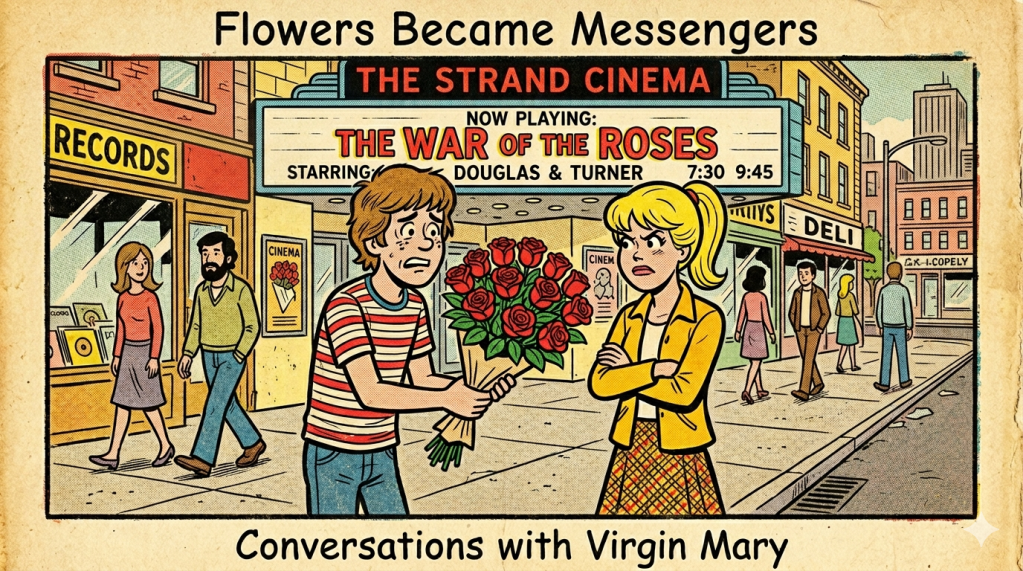
Conversations with Virgin Mary
My brother visit makes me wonder about gardening. He saw the gardens of the neighborhood, and he was asking me about the dandelion flowers, why people doesn’t take care of dandelions? In Lethbridge, Alberta, dandelions were treated as invaders. People fought them with fertilizers, herbicides, and endless mowing. Here in Ontario, entire lawns turn yellow every spring and nobody seems particularly concerned.
My first answer was: “It’s about bees, dandelions are the first feed for bees during spring, we need bees for crops, so the municipality is pushing the idea that dandelions are not a weed, or at least not a bad weed, it’s part of an ecosystem, it’s part of our own food.
He was not convinced but I realized that after several years living here, dandelions are now part of the landscape, they don’t bother me at all. The well-maintained grass with no weeds doesn’t apply here. We prefer bees than a green carpet that only ask water and won’t give anything back.
The conversation stayed with me for the rest of the week. If anyone knew something about bees, I thought, it would be Jorge.
“You have flowers in your house! It smell at spring!”, I started the conversation noticing a bouquet of red roses in the living room.
“Well, this week is our wedding anniversary, flowers is the less I can have.” He answered, “I’m going to prepare some tea, this is special, you’ll see.”
As usual he starting by boiling water, while we wait he handed me a new letter from Virgin Mary
Saturday, April 26th
Stop measuring your life like a machine. Stop forcing it into a rigid path from point A to point B as if a straight line were the only valid form of movement.
Mathematically, it makes sense. In real life, it rarely exists.
The shortest distance between two points is a straight line—but no one said your life has to obey geometry.
Think about bees and flowers. The way they find their route is not by optimizing a single path, but by surveying an entire field, including areas where there are no flowers at all. There is a reason for wandering.
So put a vase with flowers on your home. A vase half filled with water and a dozen flowers.
You will say there is no practicality in it. Flowers will not feed you. They will not help the environment. They will not clean your house, fold your clothes, or pay your bills. Quite the opposite: they cost money.
And yet there is a multi-billion-dollar industry built around flowers.
Why?
What is the utility of having flowers in your house?
Well, you are not a machine, you need more than fuel and maintenance.
You need nature. You need color. You need aroma.
It is no accident that so many animals are attracted to flowers. Plants need help reproducing. They need insects, birds, and bats to carry pollen from one flower to another. Over millions of years, flowers evolved colors, scents, and shapes that attract these pollinators.
The remarkable thing is that many of those same signals attract humans as well.
Symmetry attracts our attention. Color stimulates us. Certain fragrances relax us.
Human beings evolved in nature, not in offices, factories, or shopping malls. For thousands of generations, landscapes filled with flowers often signaled something important: water nearby, fertile soil, fruits to gather, and animals to hunt.
Flowers became messengers.
Their message was never intended for humans. It was intended for pollinators.
But humans learned to read the message too.
Where there are flowers, there is life.
A bouquet can change the atmosphere of a room — not because it performs a task, but because it reminds us, consciously or not, that we are part of a living world.
This week, your task will be simple.
Buy flowers.
Place them somewhere in your home.
Then pay attention.
Observe the room before and after.
Observe your mood before and after.
Observe whether the house feels different.
I will send a messenger after you complete your task.
“So, we react to flowers, they’re messengers of a code that we cannot understand today”, I started, “I mean, we grow now in cities and we’re not looking for a new place to live based on flowers or hunting”.
Jorge was very focused on making the tea, almost as in a trance-like performance as if he hadn’t heard a word. He took a small box with something similar to dry leaves in the shape of balls and put one ball in each cup.
“This is Blooming tea; it is a Chinese artisan tea made by hand-tying dried tea leaves around one or more dried flowers. When steeped in hot water, the compact bundle slowly unfurls to look like a blooming flower” He said as if he were in a ceremony. He took the kettle with hot water and started to pour it into the cups. Almost immediately the flowers started to bloom, he passed one to me and stared his cup for a minute or two in silence. Then he went to the pantry and came back with a jar of honey.
“Do you remember this honey?” He asked me while he was showing me the jar with a cloudy honey. I remembered that honey from one of his neighbours with a taste of wax in it.
“Today is not a day to ask about why we are here or why we lost our perception about hunting or fruit gathering” Jorge said as he grabbed his cup and stared at it. Today is my wedding anniversary and we’re celebrating, celebrating life and celebrating love”.
“Serve yourself honey.”
After that, I remained silent. I didn’t want to interrupt the moment with questions about my art rejections or about my mother. For once, I stopped looking for explanations. I drank the tea, watched the flower floating in the cup, and simply appreciated the moment.


Leave a Reply